Surrender: Weekly Reflections on a Personal Project
Tuesday Reflections on my journey towards a computational model of dissociative amnesia

Week of June 30th through July 6th
Personally, I think there are a lot of reasons for success people don’t tell you because you would never want to embody them. Success is always painted out like a good strategy or wisdom.
I’m not a CEO but I would say I’ve been relatively successful in life so far by typical metrics. I graduated from an Ivy League school in undergrad. I almost have a master’s degree from a good school now at 24, considering I finish this project. And I’ve made it through most of a the way of a very large and ambitious project without quitting so I’m assuming I will make it through to the end.
I’m persistent. I’m also stubborn to all get out. I want to see myself do well in life. Part of that comes from a crippling anxiety of struggling financially the way my parents unfortunately had to when we were growing up. I’m afraid of failure. I never feel like I’m doing well enough. I’m extremely self-critical. I never let myself take a break. I’m convinced I’m about to lose whatever progress I’ve just made in life and go back to square one. I’m constantly worried I’m on the edge of catastrophe so I’ve been forcefully pushing myself to the point that I see myself as successful so I can relax and trust myself. Will I relax at that point? Let’s see.
For many of us, success is a lot of passion mixed with a burning, all-consuming fear of not reaching an imaginary place where you are truly safe, and once you’re there, you’re usually terrified of losing it. That’s a secret to success that nobody says out loud.
People tell me to relax all the time. They’re probably right. I should. But sometimes I think they just don’t get it. When you have something you feel like you need to see in the world, a powerful vision of what the world could be or what life could be, it unsettles you to exist in a place where it’s not there yet. From the minute you see it in your mind’s eye, the word shifts. It’s like everything around me just feels wrong. Things around you stop making sense and the only thing that would make them make sense would be to hold that thing in your hands, to see it living and breathing, to see it touching other people’s lives. It feels like it would make the world feel right again. So even when you make yourself “relax”, it doesn’t feel relaxing. It feels weird, like something is just missing and you’re just making yourself ignore it for a little while.
This is something I definitely need to go to a therapist about, and it’s also my reason I’m here right now. See the issue? I haven’t spoken to a whole bunch of very successful people, but I imagine that I would see the same burning need to see something alive combined with a pervasive paranoia about loss and failure. Obsession.
I’ve been struggling to get out of bed in the morning recently, not because I’m depressed but because my batteries have been pretty low.
Even though I’m doing overall less now with masters out of the way and not working a second job, it’s been a very creativity intensive time in my productive life. We’ve been trying to get my company rejuvenated which has required a lot of creative strategising and thinking outside of the box. I’ve been making TikToks, writing essays, and trying to brainstorms new ways to reach new audiences on a bit of time crunch. I’m also in the part of my project that requires a bit more of the skills that I just developed or am developing now as I try to figure out how to get my experiment to actually run and move into the results section. To top it all off, I’ve been having the richest, most colorful, full-length movie dreams for nights in a row. My brain keeps eating into my resources without my consent!!!
I’ve already had burnout for about 4 years straight from my “Serious Mental Illness” to “Title IX/Senior Year Survival Battle” to “Childhood Home Move Out” to “Instant Move to London” to “Oh My God Will I Make It Here” to “Learning a Brand New Subject/Masters Degree” mega-run. It’s been getting much better but it’s also been hard to get myself up when my batteries are low to do high-intent activities of mega-importance in the biggest areas of my life. Maybe I should write an article on burnout for my job or something. Maybe it’s a sign.
I was having this same struggle on Wednesday, the same day I was meant to meet my other supervisor in person for the first time. My naturally anxious self was inclined to make some massive deal out of it and get uber-prepared and all this stuff but I’m gonna be honest, I tend to do that type of stuff for absolutely nothing so I decided to take it about 3 notches less seriously than normal. I’ve been doing my silly little EFT tapping every morning to just force myself to do one motivational activity without getting up and it helps me get out of bed a lot. It’s also been helping me root through some underlying feelings. Recently I’ve been thinking about lack versus abundance and how when you treat every opportunity like it’s an absolute miracle you got it in the first place and it needs to be the thing of all things, you’re stuck in a state of lack. I tend to do that a lot. It’s really not that serious! I was most interested in asking him about his career and just connecting, not necessarily talking about what I was up to.
One thing I have been thinking about though as a general area of improvement since last week is my communication skills. I’ve always felt like a significantly better writer than speaker. I am more of a quiet person in general who likes to listen more than share. I tend to get pretty tongue tied when I’m nervous and suddenly I’m jumping all over the place and losing the plot. I think my issues at last week’s meeting were a touch of that. Even if what you have is great, if you can’t communicate it well, it’s hard for people to really understand and properly engage with your idea. I also would have benefited from graphs, which are my goal for the week. As I near the end of my project, I am rapidly approaching a time when I will have to share these ideas with other people, maybe even through something like a conference. This project has been an amazing way to highlight and guide me through my biggest areas of improvement as I’ve needed them and it’s probably the right time to start working on that. I have a plan for that, which I’ll mention later in the reflection!
Everyone has weird bucket list items of some kind. Mine is that I want a celebrity sandwich at my hometown, which is the highest honor possibly bestowed upon any man.
Dolly Parton has her own sandwich in a little shop in Rochester, New York. It’s a hot turkey sandwich with lettuce, tomato, bacon, mayo, and American cheese. Simple but iconic.
Maya Angelou has a sandwich in Southern California. It is made of vegan steak, lettuce, tomato, cheddar, yellow BBQ sauce, and the house sauce of the cafe, which is a top secret seasoned mayo.
Michelle Obama has one in D.C. at the Good Stuff Eatery. It’s a turkey burger with veggies and Swiss cheese on a whole wheat bun.
I know just where I would want it too. It would be at Crossroads, which is a coffee shop I went to countless times throughout my childhood when I was late to school with my dad, before sledding in the park, and while my parents had boring meetings with their friends at their second location around V.C.U. I played a lotttt of Operation and assorted board games at that spot.
A strong second contender is the significantly more obvious choice, Coppola’s Deli, which is an actual sandwich shop.
I haven’t decided what sandwich combination would best represent me, though. My favorite Crossroads sandwich was a grilled cheese with multiple types of cheese and tomato. I crave that sandwich all the time and no other grilled cheese has ever compared, so maybe it would be some variation. On the other hand, I could see some type of grilled brie, jam, and ham or bacon situation, which I ate for the first time in London and have eaten many times since. Or maybe not. Maybe I’m not thinking outside the box enough.
This is my whimsical and highly motivating career goal.
I have some terminology and conceptual switches I would want to make based on what I’ve discovered through this project.
First of all (and I say this as I do my own somatic healing exercises to work through my own experience), I don’t like the phrasing that your trauma is “stuck” in your body or “trapped”. “Stuck” gave me claustrophobia for years and had me running to seek out anything I could do to get this thing “out”. It implies that you have some horrible parasitic thing inside of you that you have to remove. But that’s counter-intuitive. Your trauma is patiently waiting in line for you to have the time and capacity to attend to it, like a child who would like to speak to a busy parent. Trauma does not require you to surgically escavate it, and ironically, I think therapists treating themselves like surgeons was what caused the false memory controversy in the first place. Trauma wants you to have more space and silence to consolidate it. It can’t do that when you’re noisy, overwhelmed, or surviving. Your work is simply to make the space for a good conversation or to feel what it is trying to say, which is something that can take as long as you need and work around your emotional schedule. You don’t have to converse when you have the space to or fill your schedule with it. If something is “stuck” on the other hand, we’re in a state of urgency. “Rush” and “force” is the enemy of trauma in just about every potential circumstance.
Ironically, choosing to let it be and making peace with it can often do more in terms of helping you process it then getting actively obsessed with attending to it, probably because you give your body and mind some quiet time to consolidate your life. People forget or don’t know that you are designed to do that work automatically just through how your biology is designed. That’s why time heals all wounds. It’s kind of the same energy as people doing intense juice fcleanses to “detox their liver”. Your liver is made to do that itself as long as you’re taking good care of yourself and not overworking it in different ways. Some people might genuinely have a bad liver form health issues and maybe they would benefit, but because that language proliferated out into the general public, people got it in their heads that they needed to do the same thing all of the time. The average person does not need a liver cleanse, just FYI. Similarly, not everyone needs to be thinking about repressed trauma and somatic healing and inner work 24/7, not even people with trauma, honestly.
The striking difference was that while many of the African and Indian subjects registered predominantly positive experiences with their voices, not one American did. Rather, the U.S. subjects were more likely to report experiences as violent and hateful – and evidence of a sick condition.
The Americans experienced voices as bombardment and as symptoms of a brain disease caused by genes or trauma.
One participant described the voices as “like torturing people, to take their eye out with a fork, or cut someone’s head and drink their blood, really nasty stuff.” Other Americans (five of them) even spoke of their voices as a call to battle or war – “‘the warfare of everyone just yelling.’”
Moreover, the Americans mostly did not report that they knew who spoke to them and they seemed to have less personal relationships with their voices, according to Luhrmann.
Among the Indians in Chennai, more than half (11) heard voices of kin or family members commanding them to do tasks. “They talk as if elder people advising younger people,” one subject said. That contrasts to the Americans, only two of whom heard family members. Also, the Indians heard fewer threatening voices than the Americans – several heard the voices as playful, as manifesting spirits or magic, and even as entertaining. Finally, not as many of them described the voices in terms of a medical or psychiatric problem, as all of the Americans did.
In Accra, Ghana, where the culture accepts that disembodied spirits can talk, few subjects described voices in brain disease terms. When people talked about their voices, 10 of them called the experience predominantly positive; 16 of them reported hearing God audibly. “‘Mostly, the voices are good,’” one participant remarked.
Why the difference? Luhrmann offered an explanation: Europeans and Americans tend to see themselves as individuals motivated by a sense of self identity, whereas outside the West, people imagine the mind and self interwoven with others and defined through relationships.
[…]
As a result, hearing voices in a specific context may differ significantly for the person involved, they wrote. In America, the voices were an intrusion and a threat to one’s private world – the voices could not be controlled.
However, in India and Africa, the subjects were not as troubled by the voices – they seemed on one level to make sense in a more relational world.
From “Hallucinatory ‘voices’ shaped by local culture, Stanford anthropologist says” by Clifton B. Parker (reporting on work by anthropologist Tanya Luhrmann)
These things matter. So I think it’s probably just as painful to tell a group of people who are addicted to their to-do lists and chronically obsessed with closing out tasks that something is “stuck” inside them — for the same reason as the psychosis group and from the point of view of forcing people to quickly cut out the root of a perceived issue.
The other problem with “stuck”, which is probably what makes it such a desirable way to frame it, is that it implies that trauma is some type of item with finite edges, which can be extracted entirely at some point. The idea that we can “release” our trauma stops us from coming to terms with the fact that this event is always going to be part of who we are in some shape or form. It’s not going to be removed. It’s going to be part of a framework through which you see the world forever, just like every other event in your life. There’s no special “event” when trauma just “goes”. Maybe in some moments, like an epiphany here or there. But is it “extracted”? I don’t know if it is. Most of the times that I’ve felt like I really released trauma happened through reflection, in hindsight, when I realized that at some point (and who knows when that point was), it just stopped really mattering to me like it used to. Nothing announced itself. I just had the realization one day that I hadn’t thought about it in a long time, or it didn’t feel like anything to me anymore.
I have also thought a lot about the idea of “recovered” memories. I guess it works but maybe there can be a better way of understanding it. “Forgetting” is a very intuitive understanding because at some point you did experience something and then you could not access it. But it didn’t just “slip your mind” like an oopsie. You didn’t “remember” it. You struggled to consolidate it, rendering it inaccessible, and then you did consolidated it when you had the space to. Something was working slow or with a buffer. It’s like buying groceries and reaching for them in the fridge — only you didn’t put them in the fridge yet. They’re still inside the bag.
I guess I’ve been wondering (if more research backs what I’ve come across with trauma memory) if there could be a more mechanistically-accurate phrase for a “recovered memory”. I haven’t come up with a low-baggage phrasing yet (because “recovered” carries a lot of baggage). But I’ve been thinking about it. Maybe it just needs a little bit of a rebrand instead.
I was extremely nervous leading up to my meeting. On the train ride over, I suddenly started to feel extremely under-prepared. “What am I even here for? What am I going to say?” I spent a good 30 minutes at a coffee shop before having a mental prep.
I finally just gave up and listened to the coffee shop Bossa Nova for a little while. I think it soothed me. I got an image of me at my frumpiest, having come home from a nanny job, just making videos on my MacBook. If I was speaking to a professor in a program I felt legitimate in, I don’t think I would be as nervous. But this is my child of a project that I started at random. I didn’t work my way up here. I’m not even really going to just look for some kind of research assistant opportunity. Every meeting I’ve had has felt very high pressure for me because I feel like I flew up here by the seat of pants off pure determination. I feel horrible imposter syndrome and maybe I’m worried people will see through me, like I have a fake ID and a costume part to crash their party.2
As you may have already guessed, it turned out completely fine and was a great meeting. I learned so much from my supervisor. It was so great to get his insight from a fresh perspective and it inspired a lot of fresh questions about my work. One of the most interesting things I learned was that no one knows exactly what REM sleep is for which is fascinating. Apparently certain antidepressants completely wipe out REM sleep and it has no perceivable impact. But when the antidepressants are weaned off, there’s a month or so of a rebound, if I’m remembering right, implying that it must be useful for something. Neuroscience is so funny because there are so many unanswered questions in areas you would never guess. It’s not just the “weird” or unusual things, like rare disorders, that have lingering questions but also everyday experiences you could find in anyone. Brains are so mysterious.
This project has had me thinking often about how k-12 teachers should start teaching children not just what we know but also all of the odd things we don’t know. I personally think this would have piqued my interest greatly as a child and showed me my own incentive to get to know science better. I thought science was just looking at random cells and putting things in test tubes. I didn’t really relate to it that much. It is a lot of that, but just that alone is significantly more mysterious and exciting than I would have expected as a child. Kids are much more excited about “we have absolutely no idea what this means” than authoritative question answering in general, I think.
“An adult doesn’t know the answer to something???”
I also had no idea how personal science could be as a child because we are encouraged to identify ourselves as either humanities or STEM people from a young age. I always wanted to make a societal impact or be a great writer when I was younger, so I mentally tuned out in all of my science classes. I was very social justice minded all the way back to my childhood. Learning how to think in a cross-disciplinary way when I was older was a luxury we don’t get as often in K-12 and that was what sent me down my science route. Science is so political as well and touches people’s social lives often. We think there’s nothing “emotional” about science because it is a discipline of “facts and logic”. From the perspective of my project, I would argue otherwise. Trauma science in particular is extremely social. It goes into the way we relate to each other, our biases, the way our communities are set up, and so much more. For example, how does hippocampal ACh look in the brains of inhabitants of an extremely noisy and dangerous neighbourhood versus a well-funded, clean, and quiet one? The mechanism is the same for everyone, but the way it’s going to show up is probably going to be quite different in both places. I dream of an educational format where History teachers and Biology teachers would team up to develop shared assignments on how sustainability has changed over time, or English teachers and Chemistry teachers would teach a joint lecture on the history of chemistry from a literary perspective. We do it in college all the time! Why not K-12?
Anyways, I ended up up on a fun adventure through central London just to take advantage of the trip up. I love looking at ancient art, from a neuroscience perspective. The fact that we felt naturally called to write and create symbols is so interesting. There hieroglyphics are so clean, they could have been designed on photoshop or something.
We weren’t just called to make random scratchings on the wall but highly stylised, unified, and repeatable images. That was just intuitive to us. I think that’s weirder than we give it credit for, even if we know why it happens.
We are also innately spiritual, for the most part. Or we collectively felt that inclination in unique ways from completely different places and it never fully left us. That’s pretty interesting too.
We’ve always loved to represent the world around us, not just experience it. And we’ve loved comedy for forever! We’ve always wanted to make each other laugh. Other animals love to play. Do they find things funny too?
On Thursday morning, I finished “I Will Teach You To Be Rich”. It changed the way I thought about money a lot.
The first financial literacy book I ever “read” (aka listened to as an audiobook) was “Financial Feminist” by Tori Dunlap which I’ve been wanting to purchase again as a physical copy so I can reference it. They’re similar on a lot of fronts, but have some different philosophies. For example, Tori Dunlap has the “Financial Game Plan” which is a great step-by-step list on where to start with your financial journey. Step One was building an emergency fund using a High Yield Savings Account (which I had never heard of and have since opened and filled — and emptied — a few times in my London life). She also discusses the psychology of money often in her books and podcasts. I really loved her approach as a young person who wasn’t raised with financial education as a big feature of my upbringing because it made the path seem manageable and simple. I highly recommend her book to anyone but especially women since she dips into the importance of financial education from a feminist standpoint as well.
“I Will Teach You To Be Rich” gave me more of a long-term perspective on the nitty gritty details of building wealth, including what my financial setup could look like from my 20s all the way up into retirement. His big focus is on helping you build a good system that is personalised to you and the life you want for yourself. He talks about things like “asset allocation” and “prenups” and “large-cap stocks” which I would not have imagined myself understanding so clearly but felt really simple and intuitive in context. I’m sure “Financial Feminist” covered some of the things I read as well but it’s been a while since I listened to the book so it was a lot of new information and a good review of everything I probably heard for the first time there. “Financial Feminist” was a great first personal finance book for me at 22 and “IWT” was a great second book to read a few years later at 24 when I already had a masters degree and was ready to start envisioning some bigger future plans. Either one is honestly a great starting point or continuation point from wherever you are unless you’re already a millionaire or something.
They’re definitely going to be books I keep forever and reference again and again at later times in my life.
And now onto my next “Personal Project Nesting Plan” self-help read. I mentioned earlier that I don’t feel like the best speaker, but I want to be. My next book is “Talk Like TED: The 9 Public Speaking Secrets of the World’s Top Minds” by Carmine Gallo. I bought this book at the same time I bought “IWT” and “Why Men Love Bitches” (and “How to Drink Wine” by Tom Surgey). I had a vision!
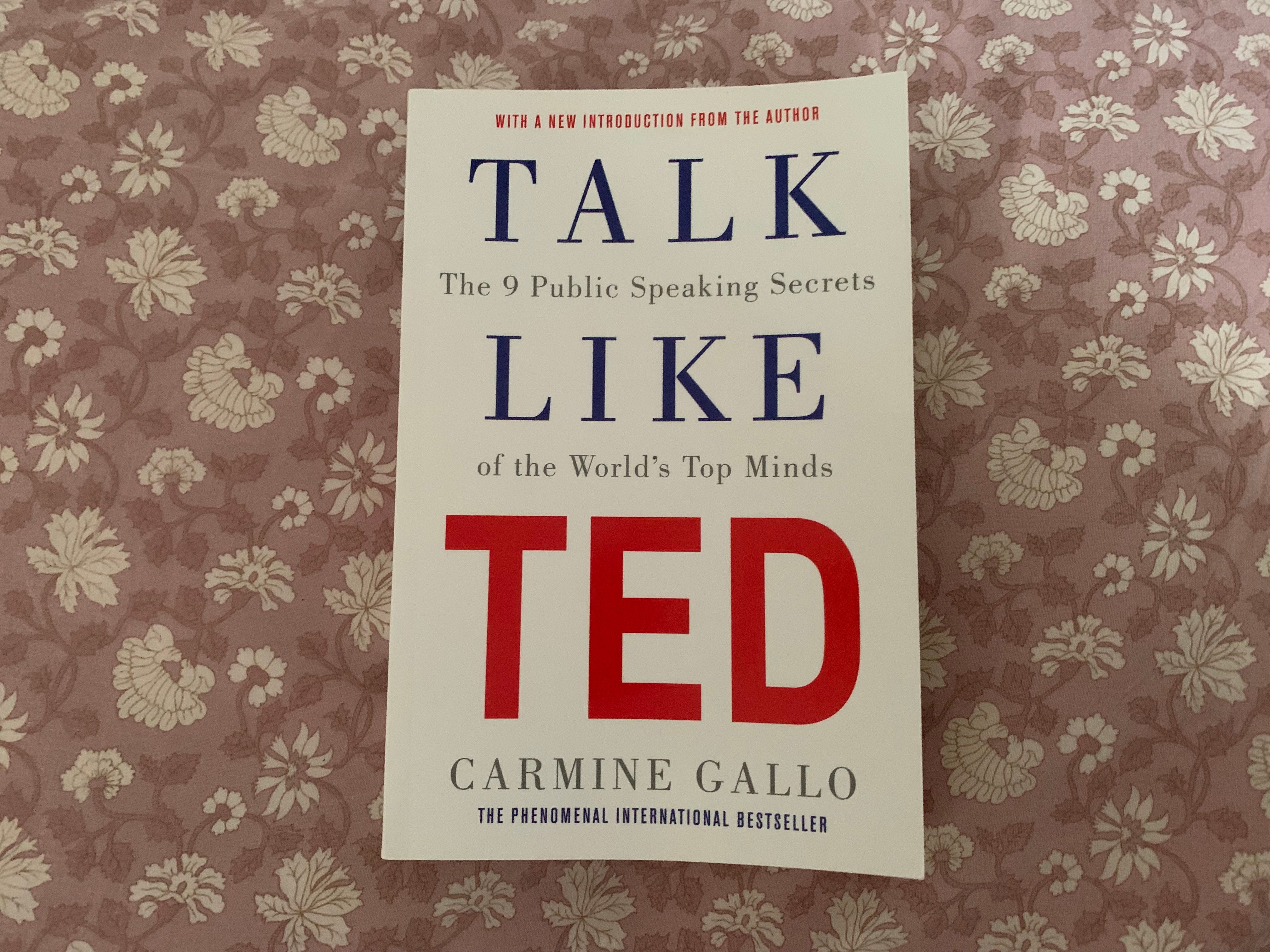
“Talk Like Ted” is a nine chapter book, and I will follow the same method as before. I’m going to read one chapter a week, which should take me past the due date for this project, which is in a month and a half. My goal is to feel like I can confidently speak about my project in an engaging way to someone who has never met me or heard of my project before.
I briefly wondered last week when I pulled it back out and Thursday when I started it again whether it was worth triggering myself right now. Love is a 101 page book with big borders and small pages. I figured since I was on a roll from the piano teacher, I might as well conclude the sequence. Ive been in a really good place recently.
Still, it was making me cringe more trying to read it now with more access to my body and experience than last time when I was extremely dissociated.
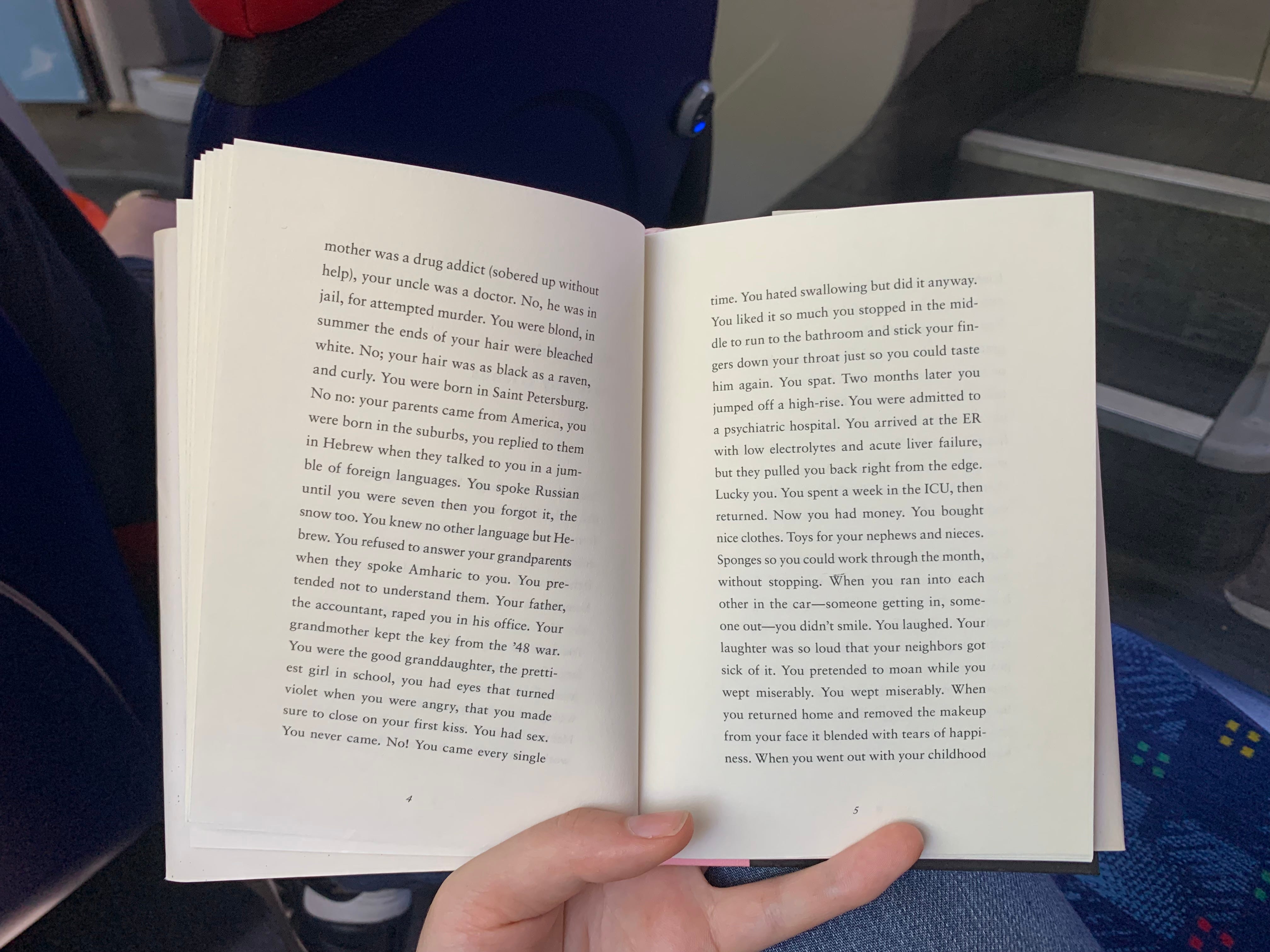
I’m constantly in tension with how to trigger myself strategically. I’ve done a lot of avoiding over the past few years to the best of my abilities. Sometimes it makes me feel stuffy, like I want breathing room to spread out a little. I want to work with disorders you frequently see coinciding with sexual abuse. Im interested in it academically. I want to work with survivors in my own career and from a political standpoint. I want to have conversations, hear stories. But I’m still avoiding news stories. I’m still avoiding memoirs and interviews.
Developing a tolerance for what triggers your after trauma is like weightlifting. If you never do it ever again, you’ll feel weak and incapable. If you start lifting 100 lbs right off the bat, you’ll probably fail and in the off chance you’re able to to it, you’ll hurt yourself and be out of the game for a long time. If you pick something at your level but never give yourself recovery time or do countless sets to speed up the process, you’ll get sore and lose your ability to do anything over time. These stories are fictional. But they can feel just as real sometimes. Part of healing is letting yourself be triggered too. I determined to take it 10 pages at a time, setting the book down and taking a long break. After this book, I have a much lighter one planned, which is the memoirs of Vashti Bunyan, one of my favourite artists.
It’s been informative to learn what bothers me, though. This one has already been sitting heavier despite being about sex work, not a predator. I think it’s because it’s about young girls. Just the first ten pages felt like a stone in my stomach. I don’t want to quit the book a second time but worst case scenario i alternate or skip to vashti Bunyan. Sex work is a complicated spot between consent and economic or psychological coercion that toes a very difficult line right into assault. Nowadays, the internet has made it so that even the most financially stable women might engage in sex work. However, when it comes to those who do it to survive, I still wonder how far that really stands from being coerced into a sex act.
I’ve still been processing “The Piano Teacher” in many ways. I actually had very fitful sleep on Wednesday night. I dreamt that one of my male friends was assaulted by a woman, just like in the piano teacher. I got angry at the woman and told her to apologise instantly or I would expose her to everyone. She just kept laughing and laughing like it wasn’t serious at all. The context included a weird mashup of my experience and that of “The Piano Teacher”.
I actually woke up in a fine mood though, even cheerful. Sometimes dreams sit heavy on my mind all day. I guess that’s what I mean by letting myself get a little triggered. Processing isnt a bad thing but your body will tell you when something is enough. I think 10 pages was more than enough this time.
I’ve been having a think about where life is going recently and how I feel about it. I’ve had horrible adulting anxiety for years that often feels counterproductive. I feel surprised when things go well for me and I expect them to go badly, even when I follow the right steps. Everyone around me sees me as a very responsible and hardworking person but I see myself as an irresponsible slacker who gets by on sheer luck. I amplify my mistakes and downplay my successes. I had a think about that as I irresponsibly had a latte and went for a walk along the water.
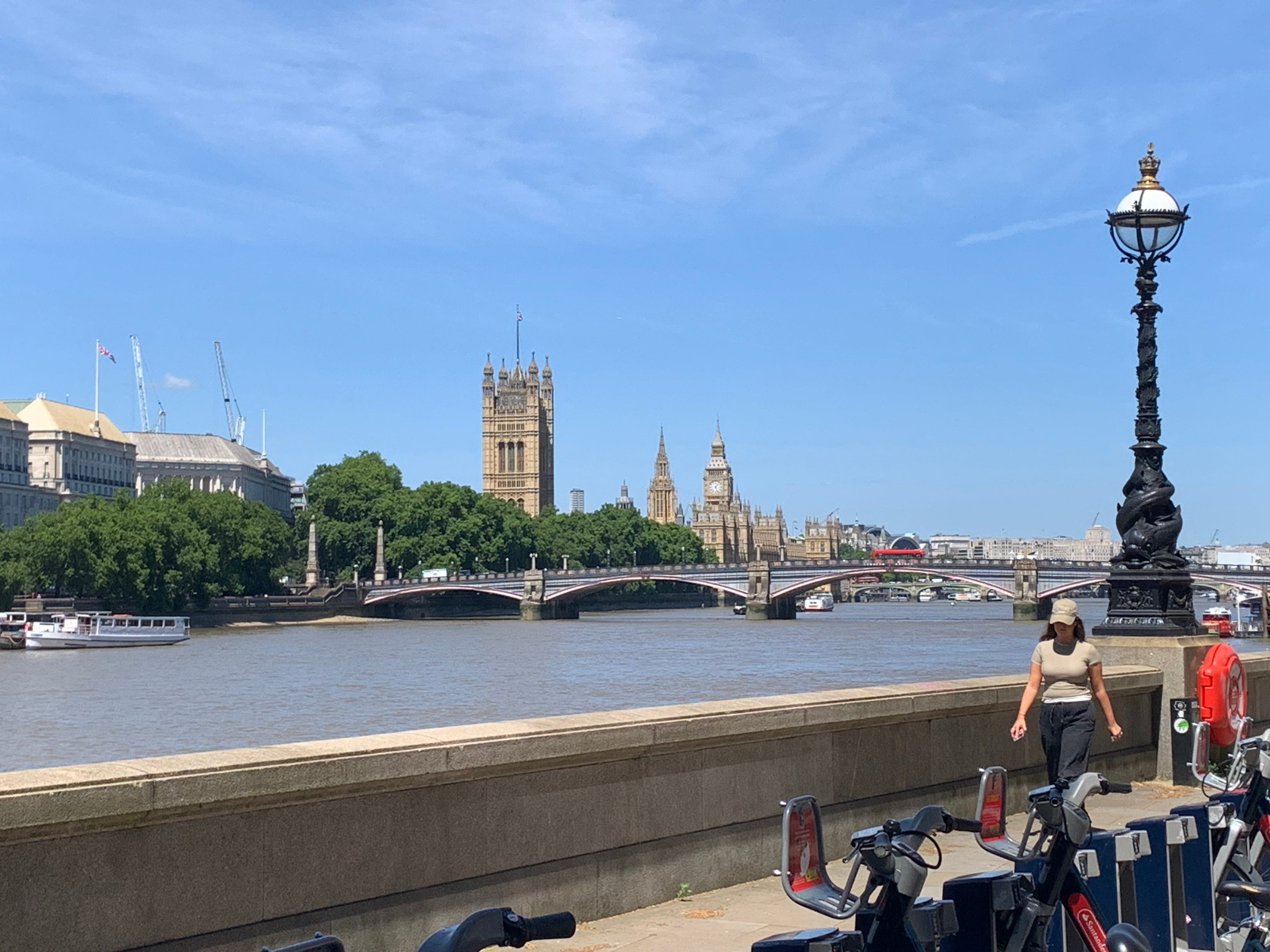
I realised I was holding in a lot of anger and resentment towards myself. College was kind of a disaster period. It added an additional challenge to my adult life I never expected to have when I was younger. When things when wrong, even mildly, I internalised that I had made bad choices. Being in London has been a good career choice in many ways. Going to UCL was a great opportunity. I have a masters degree earlier than most of my friends. I got a few great job titles on my CV. I’ve also never contributed 30% of my income to rent or 30% to savings. My savings are quite meagre. I have a friend who’s currently freaking out about making only $36,000 after tax to live in a small middle of nowhere town. That one was a real hit to my financial self esteem because I’m nowhere near that yet. I think there were years we made rhat amount for my entire family of 4. She’s a 25 year old and a dog. When I am annoyed at myself that im not as ahead as I could be, I wonder if I should be like my friends who lived at home and saved. I guess I’ll have to assume the answer to that is “no” but I think every decision you make is a trade off. I made investments in my career and in my skills.
When I was younger, I assumed I’d be the kind to follow the exact best rules financially. I’d never live paycheck to paycheck. I’d have a lot in savings. I’d make every sacrifice to scrounge up and be stable. I’d plan everything to perfection, prepare everything, and always make the perfect choices. I didn’t account for the fact that sometimes life has an alternative plan for you that requires a lot more spontaneity than expected wnd will bring a lot more out of you than you thought you had in you. A little bit of chaos and shuffling around (okay, a lot) is not a negative reflection of my personality. It’s part of life. I pride myself in being pretty good at predicting things. But I can’t predict everything. No one can. If a paid investment expert can’t predict the stock market well enough to beat it most of the time (or so I learned), how can I, a life novice, expect to predict something as chaotic as life even a little bit of the time?
I actually think if I wasn’t so horribly suspicious of myself all the time and waiting to slip up like I’m my own worst enemy, I would go a lot further.
I had a bit of an imagination session on Thursday night about my life in another Universe. I was thinking about the other college I had gotten into before getting selected early decision to Columbia, which was St. John’s College in Annapolis, Maryland. Those are the only two schools I got into before having to revoke my applications because I was admitted.
My relationship to my time at Columbia was pretty complex. I sometimes wonder what it would have been if I hadn’t met the people I did right off the bat freshman year. Obviously that would have changed things a lot. I would have had a lot more brain space to think, explore myself academically, and get immersed in campus life. I didn’t get to enjoy many of the things I was so excited to, like the Common Core, because I was busy surviving. That was pretty unfortunate. It was my dream school. I had a big poster of it on my closet that I would wake up to for years in high school and just hope really hard that I would get in. If that hadn’t happened, I would have gotten more immersed in clubs, lost my virginity in some random dorm room to a guy I’d remember fondly but rarely, probably have gone to a sports game of some kind (which I never did even once), and maybe have stayed in New York City and pursued some mid journalist career, which is what I used to want to be. I would have never gone into psychology, and definitely never have gone into neuroscience. So you win some, you lose some.
I’m still grateful that I went, obviously. It’s not a decision I would ever regret. The political climate there over the last few years has been awkward, to say the least. There was a lot I was very disappointed to learn about. That being said, my professors were so incredibly kind and some of the smartest people I’ve ever met. I was very academically challenged and exposed to philosophies and ways of thinking that changed my life. In some weird and unsettling way, I think the trauma of it all was strangely meant to be, or I tell myself that.
But on Thursday, I stared wistfully at St. John’s curriculum and wondered what that would have been for me. I truly have no idea. Funnily enough, I kind of wonder if I still would have ended up somewhere close to here right now. What I liked about St. John’s was that the curriculum was so intensely well-rounded. You learn everything, which is how I think anyways. I ended up in Comparative Literature and Societies at Columbia, which was the most interdisciplinary choice I could have made, and that led me into science. I instantly started writing about dissociative disorders, and felt dissatisfied with the lack of language I had to verbalize something brewing inside. You end your senior year at St. John’s with Sigmund Freud, Frederick Douglass, Booker T. Washington, all sorts of Physicists like Albert Einstein and Richard Feynman (weirdly I took “Physics for Poets” my senior year at Columbia), and neuroscience. Maybe I had a destiny. Maybe I was always going to end up right in this spot. Maybe it was sort of just a toss at a dart board of fate or something. Like that was the send off into the world I was always going to have that year in some way, shape, or form.
Would it have been this horribly traumatic there? Was that always going to be out there for me? Who knows. I would hope not. But maybe I was always going to be thinking about “everything” in this particular way.
This is the second time I’ve thought about fate this week. The first time was at the British Museum. I didn’t start believing in predestination until I did this project. Then I did because it just all seemed too strange. I would have never gone after neuroscience if what happened hadn’t happened, and I would have never known how good I could be at something so absolutely random. At the museum as I looked at the hieroglyphics, I wondered if all the knowledge in the world lies inside of us already and we are just waiting for some higher power to draw it out of us. Nature or something. We just knew to start writing, in so many different places at once. That’s what gets me. It wasn’t really an invention. It was natural.
If you’ve ever written a poem or made an art piece, you might resonate with the feeling of looking at your work in a state of complete stupefaction. Sometimes you make something and you weren’t really thinking about what it meant. You were just pouring out in a flow. But when you look at it again, you see everything you could have said if you knew the words were in you. You convey things that you didn’t even know you were trying to convey but when you see them in that context, they just makes sense. It’s like a flower opening its petals, or a fractal expanding to reveal parts of itself you didn’t expect.
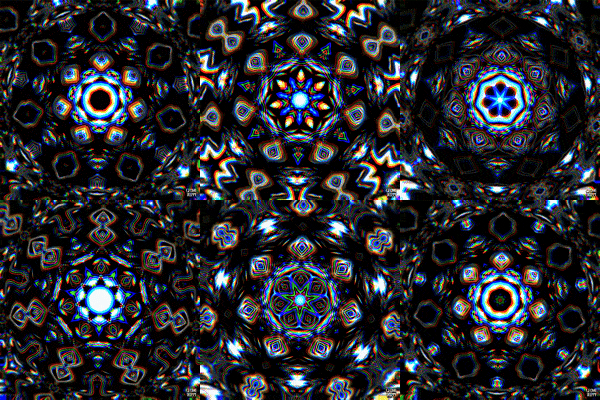
Sometimes I wonder if the world is just that. We don’t choose anything. We blossom. We just open up over life in a completely natural way, in the right places, at the right times. Maybe all of it was always meant to be.
You know, sometimes you have to make sure you remember things so you don’t forget them though. My time at Columbia was big and so full of love and feeling. It felt as musical as it felt dark and difficult. I feel like I left and just stopped thinking about it. I’ve been trying to feel again, not numb things out so much. Sometimes I feel so blunted and part of that is because at Columbia I felt so much. I was like an open sore and an open heart. It felt like a movie or something. I’ve been so up in a world of ideas and achievement and everything the last few years. My past self is so locked up inside but when I think of her I feel such a heartache and I miss her so much.
I have a friend who I fell off with in my last year for some complex reasons. He was a big part of my life. I started to feel a little concerned about the things I was hearing. Then we had a spat (if you can even call it that because it happened through someone else) and I didn’t fight too hard to talk again because I just had a bad hunch. A year later I found out from the friend we fought through that he had raped someone. It was what I was scared would happen. It was just little things that gave me a feeling, little phrases and things. I’ve always had good intuition. From what I heard, it was nowhere near as sinister or intentional as the way it happened to me. It was a drunk party. I actually asked not to hear the details because I just didn’t really want to know, to be honest. It’s sad because he was such a big part of my friend group and my support system in the first three years and we had a lot of memories together. I don’t think it’s bad to say that I really did grieve that relationship a lot and I still think of him all the time.
I’m not going to say he didn’t mean to do it because that’s not how it works even a little bit. I guess I’ll say (as a survivor myself) that he fumbled, he was very much a man in how he thought, and he wasn’t always the most aware of himself. But he did get a fold-out couch so we would be more comfortable at sleepovers, he was the first person to ever tripsit for me, he was one of my only friend during a very lonely and empty COVID year, the first person I ate “Screamer’s Pizzeria” pizza with, and someone I knew loved his friends very much. He’s someone I assumed would be a guest at my wedding one day or would meet my future kids. I think that’s a very different confession than “This guy was the best dude ever, he would never do something like that”, which we get in the news plenty.
I guess the point is love is complicated and it’s rarely worth throwing away. I myself wish we would put more work into restorative justice, the real kind, so we didn’t have to throw people away when they did complicated and difficult things. After this happened, I heard later, everyone had to distance themselves form him and he spent the rest of the year quite isolated. Nobody was going to “forgive” a rapist openly without the tools necessary because you’re basically asking to seem completely insensitive. No one wants to be the person to tell a survivor their story isn’t worth listening to, which I appreciate and I would probably have done the same in that situation. All of us would agree that he was an extremely far cry from the man who raped me, who was just toxic and intentionally predatory as a character trait. I don’t really believe there was much saving that guy, which anyone who knew him that year would confirm. But some people are worth the effort. My ex-friend was apparently the one who intentionally told everyone himself that he raped someone so they would be aware. He was very politically aware, hence this effort, but maybe not always aware of the behaviours and attitudes he internalised which would have led to this circumstance. It’s just messy and complex, isn’t it? The whole thing. We really need to do more work to help people understand how to work through and reintegrate each other when the context is appropriate, and not just for the sake of giving people who rape an out to avoid bigger consequences they should get. It needs to be more than a school official having a mediated conversation but a whole community system integrating many people into dialogues and actions that truly enact transformation. He’s someone who could have benefitted from some kind of unlearning program combined some guidance on making amends with the person he hurt and his community.
Personally, I felt betrayed because he saw firsthand how much my mental health suffered as a survivor and that didn’t seem to change his relationship to how he interacted with others at all. It made me feel like he wasn’t sitting deeply with what that experience meant for me and that made me really sad and kind of angry. Maybe really angry, I don’t know. I think I’m just fully sitting with it. I was very disappointed to hear what happened. That’s the restorative justice conversation I would have had with him, in a dream world. Instead, we’ll probably never see each other again.
Anyways, I don’t listen to music much anymore even though it used to be my life and one of the biggest things people knew me for in college. Part of that is because all these complex people and times that I love are living in my favorite songs. Avoidance. I’m working on it. Maybe I want to keep them locked up in there forever or maybe I never want to see them again, I don’t know. I’ll just say that of all of the griefs I experienced at Columbia, losing that friendship forever was one of the biggest. He loved music too. I hear him and his room in my music all the time. I always think of him when I listen to Frank Ocean.
Side note but this is the most gut wrenching song in existence. I can never listen to this one.
I feel every single school memory packaged into this one. Every bus ride, heartbreak, trip into the city, everything. Sometimes I miss being sad how I was sad instead of stressed and numb.
Being a girl is so hard.
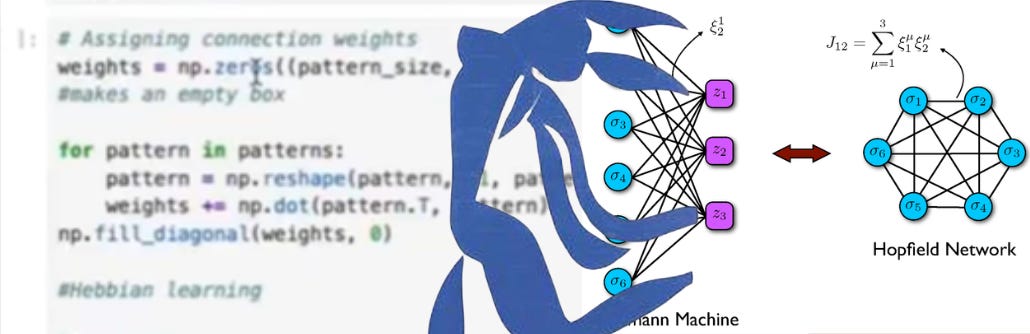
Friday was a rough day. I woke up to my cat having signs of a UTI or maybe having some inflammation, which made me feel guilty and was also another potential expense to account for. After calling a few different vets to get the cheapest possible quote, I sat down to try again with the model that wasn’t working. I decided the most logical next step would be to find a script for a working sparsely coded Hopfield Network. An initial search did not reveal any scripts, but did lead me to a few papers, all of which had to do with modern Hopfield networks (I learned that mine was a classic one), and something called “sparsemax”. I did some research, assuming maybe a sparsely coded classic Hopfield network wasn’t really a common thing. I learned that it had been done, but was classified under different terms. The classic paper for this was apparently M. V, Tsodkys and M. V. Feigelman, called “The Enhanced Storage Capacity in Neural Networks with Low Activity Level”, in which they found that sparsely coding a Hopfield network actually resulted in better storage capacity, which was an important finding.
Unfortunately, this paper did not answer any of my questions at all. So I went back and asked Claude if there was any way to find actual scripts of a classic Hopfield network with sparse coding to see if I could just compare and contrast, which is what I was searching for. Upon searching, Claude said that this wasn’t much of a common find. There are plenty of densely coded Hopfield networks online to play with. I used one myself from Kaggle. But sparsely coded? Not really. I searched Google Scholar, normal google, nothing. So I was back to square one again.
At this point I was really annoyed and decided to take a break. This piece has been really, really hard.
After lunch I laid down in bed and had a very dramatic ugly cry (no, not just about this experiment but that was a massive contributor). I had a talk with God and listed all my grievances:
My money is getting tighter again and I want to go shopping but I can’t
I’ve been sticking to a calorie count but somehow I gained weight this week
My Hopfield network stress led to me eating multiple chocolates thus interrupting this calorie count
So I can’t shop, I can’t go out to not spend money, I can’t finish my project, and now I can’t even binge eat sweets or order Uber Eats… so what am I supposed to even do to bring me momentary pleasure
In fact, my chocolate cravings are at an all time high today so what kind of cruelty is this.
This project is way too hard for me
I want to go on vacation
I’m tired of trying
It was about 30 to 45 minutes of this, after which I got up to eat a snack. All of a sudden, it struck me. The anger? The crying? The laziness? The weight gain? THE CHOCOLATE???

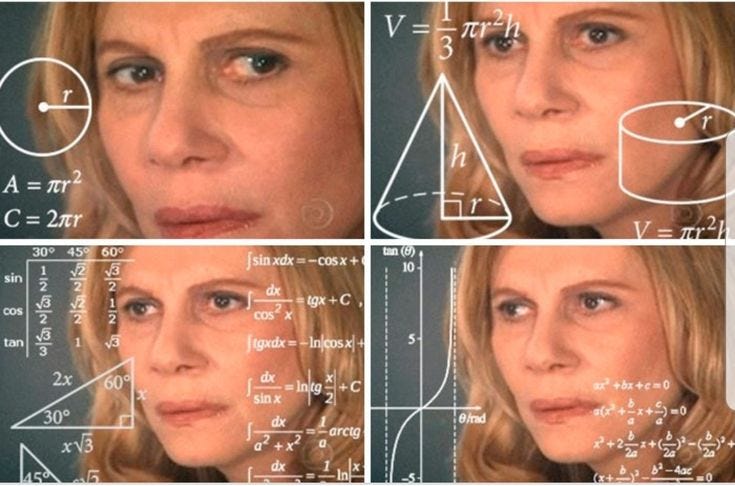
I’m PMSing, aren’t I.
Every time. Every month. The same melodrama. The same confusion.
So I just gave in and made myself a hot chocolate and decided I was not in the right state of mind for this project today.
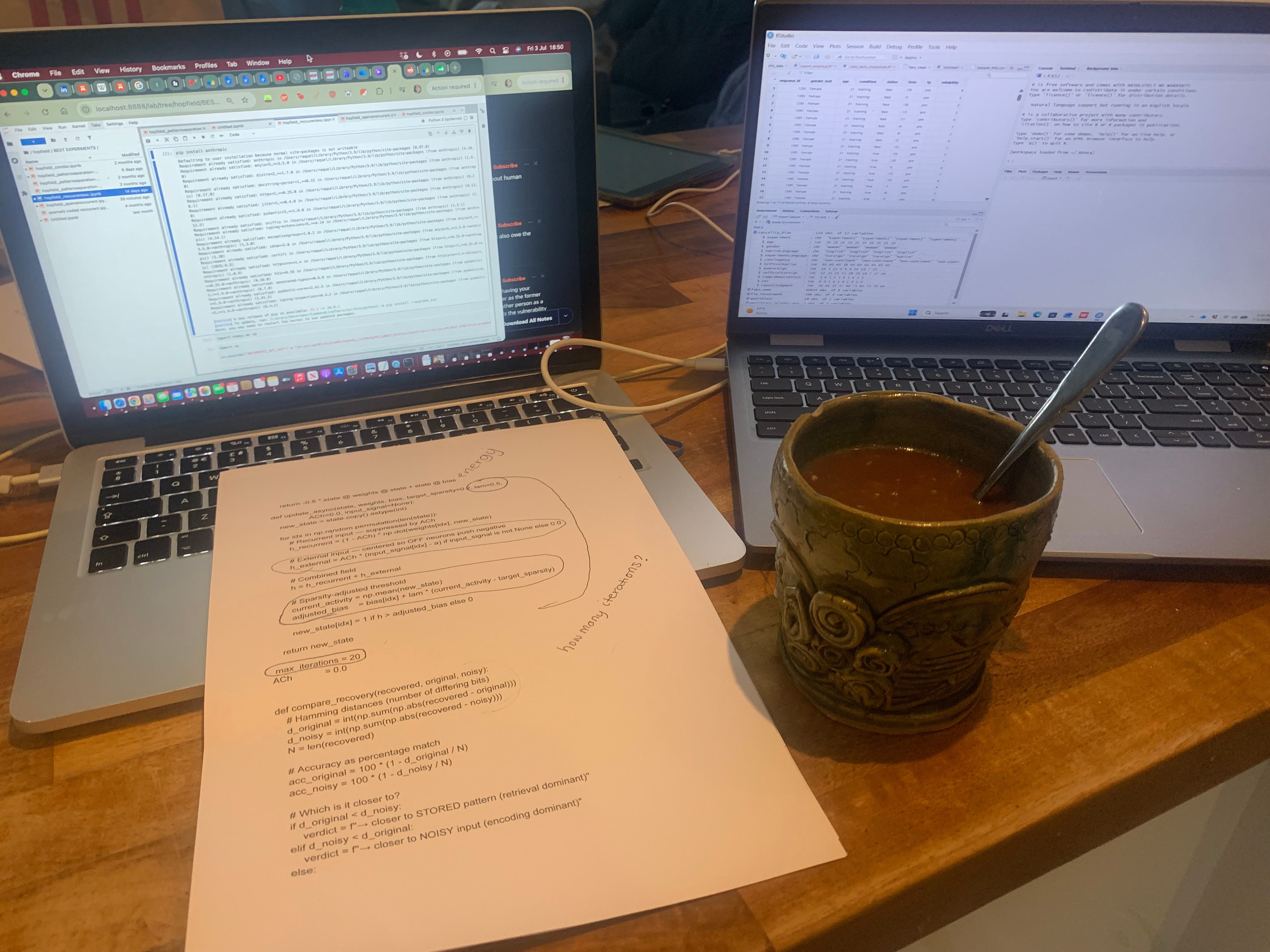
I had a flash of total brilliance at 10:22 at night on my way back from the grocery story to get my cat laxatives (in a really cool and sexy and iconic way, I promise). And when I say “brilliance”, I mean I should have instantly thought of this weeks ago.
I’d been troubleshooting the model with the Acetylcholine already in it. Maybe I should try to completely strip that and make a “normal” Hopfield network with sparse coding, and then add the ACh again afterwards. The reason I didn’t do that before is that in theory, when the Acetylcholine is at 0, it should essentially be what I just said anyways. But maybe it would help me reframe and get to the root of the issues a little faster.
I’m saying all this fully knowing that it is likely one of the one million ideas I’ve had that have failed thus far but it made me feel better to have something new to try.
Based on the day that “Love” gave me after starting it, I decided to take it like a shot and read “Wayward: Just Another Life to Live” as a more soothing chaser.
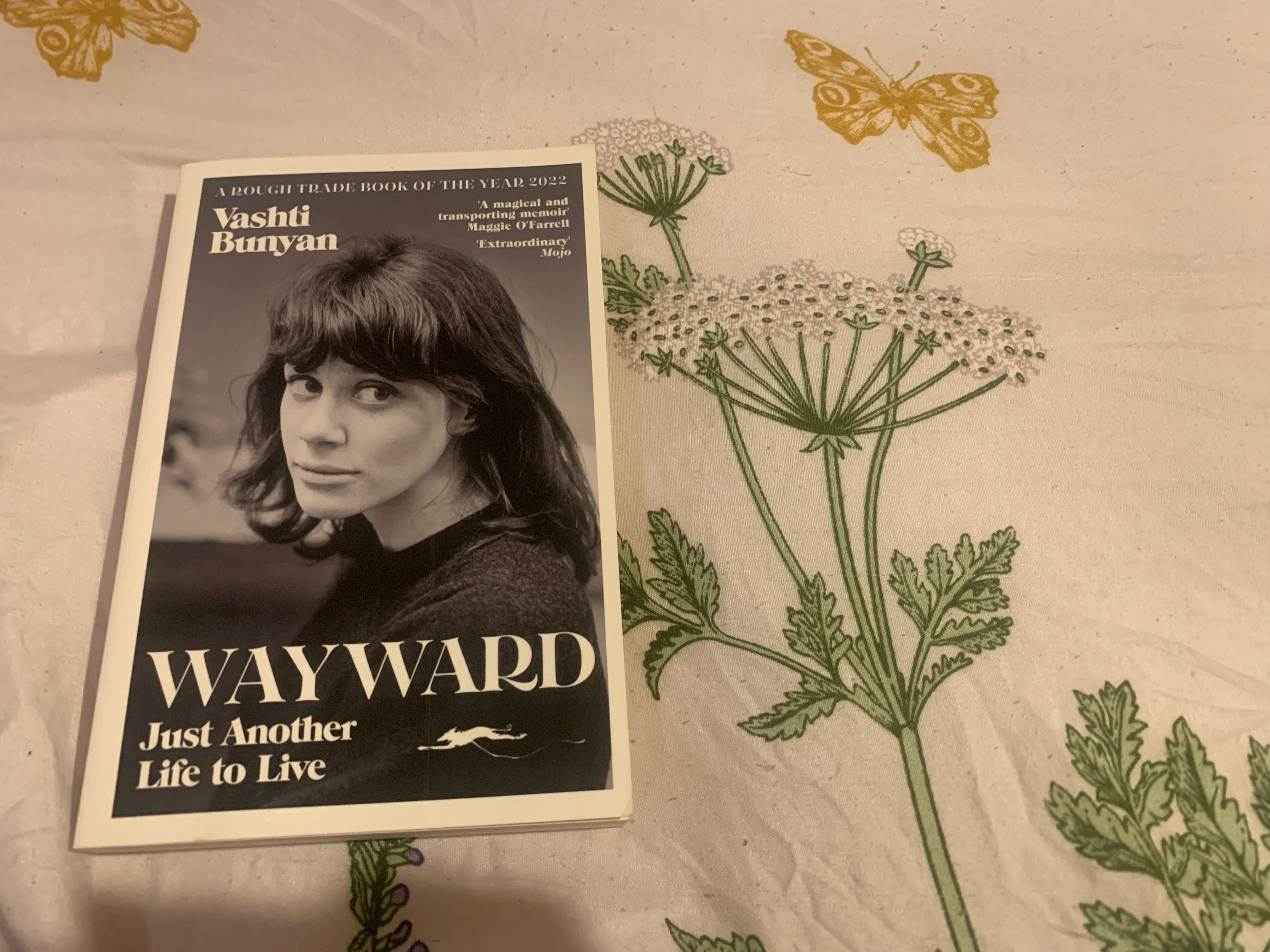
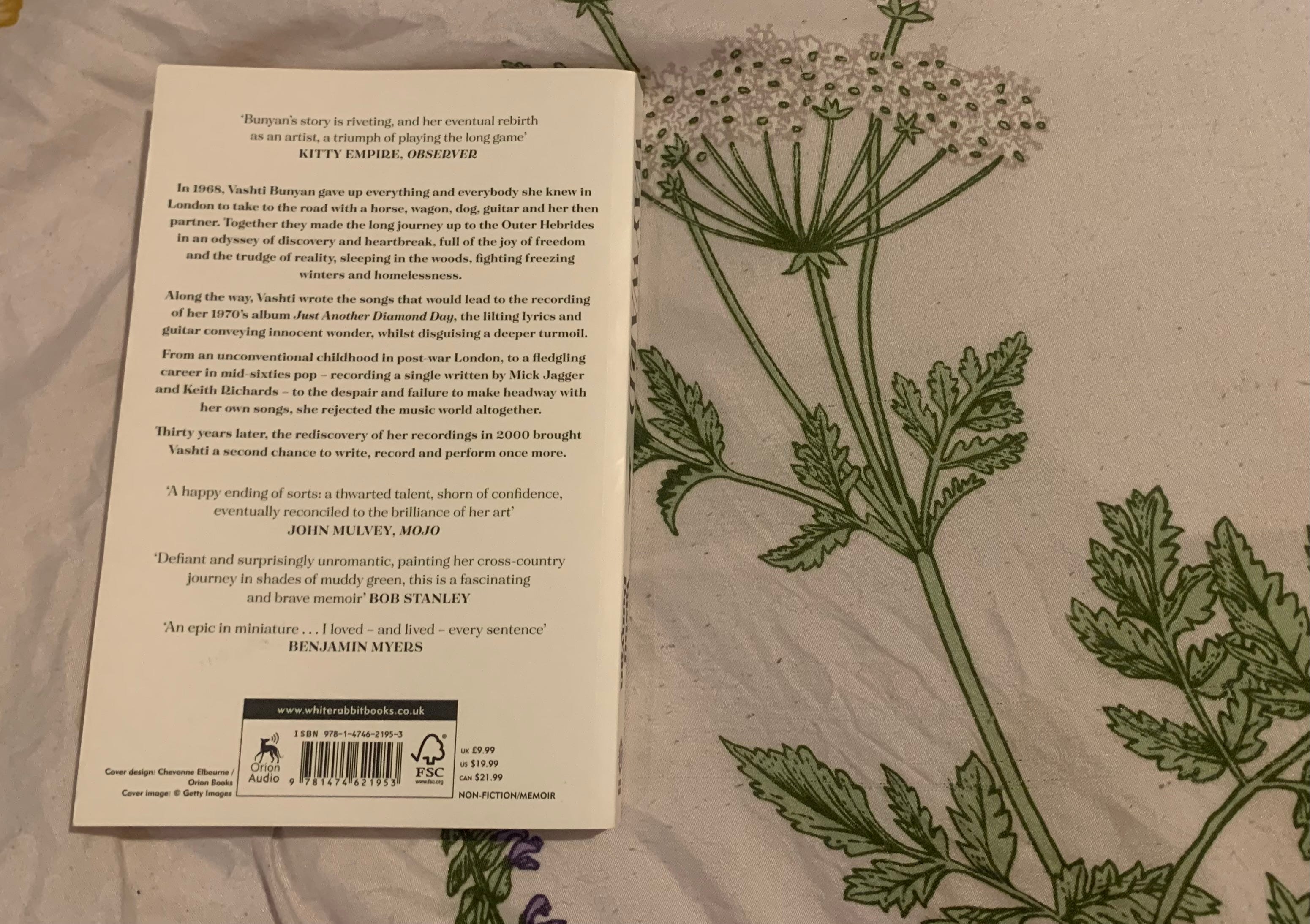
I bought this book at a Vashti Bunyan concert, which I paid only £10 to go to soon after moving to London. It was one of the most magical live experiences I have ever had. She has so many musical instruments out on stage. I can’t even describe how it sounded to my ears. I could never recreate it and I genuinely left feeling like I was floating and wanted to transform my whole life. These were some of my favorite of the night:
Imagine this but with live instruments. It was one of the most beautiful sounds I ever heard. My other favorite from the concert:
What took this one over the edge for me was the anecdote. She said she took inspiration from her then young son’s relationship with a girl he loved very much, but they just could not get on the same page. It really gave me a special relationship to this song.
She just fills me with such inner peace and whimsy.
As a side note, this video brought up memories of a movie I watched when I was about 13 and I wonder who on Earth else has seen it. My mom had to hunt this movie down like crazy to show it to me. She was waiting until I was 13, actually, so I would be “mature enough”. This was one of the first songs I learned on guitar. I’ve been missing summers in my hometown so much recently and this song always reminds me of summers in Richmond for some reason. Niche but it made me smile.
On Saturday morning, my cat and I made a run to the vet to see what was going on. I thought about acting like I trusted myself, thinking back to this week’s thought process. I then remembered some other investing advice that made me feel better about London: when you’re young, you should be investing more aggressively, meaning your portfolio could be even around 90% stocks and 10% bonds. Later you can dial down the risk to maintain your assets.
London was my 90% stocks moment and I would say it has payed off quite well thus far. It was risky but I gained a lot from it. I’ve mentioned in other articles how I’ve invested energy when I didn’t have money, like spiritual investment. Well, this whole journey has been a reflection of the gains I’ve reaped thus far from my spiritual portfolio.
I got home, forced medication down my cat’s throat, lied on the couch for a while questioning my existence, and then got back to work on my project in the evening. I made a new code without any of the acetylcholine elements, just like I planned. It didn’t immediately do the trick, which was disappointing, but that cut out some key suspects and forced me to take a closer look at the output. Upon closer look, I felt like the noisy patterns just looked… weird. I’d never noticed that.

The noisy pattern is supposed to be the learned pattern with some pieces flipped, like a picture that’s a little grainy. Mine seemed really different to me, just a little bit too off. At this point, I had a lot of trust issues with Claude but I decided to inquire, because I was too inexperienced to trust my own “vibe check” 100%.
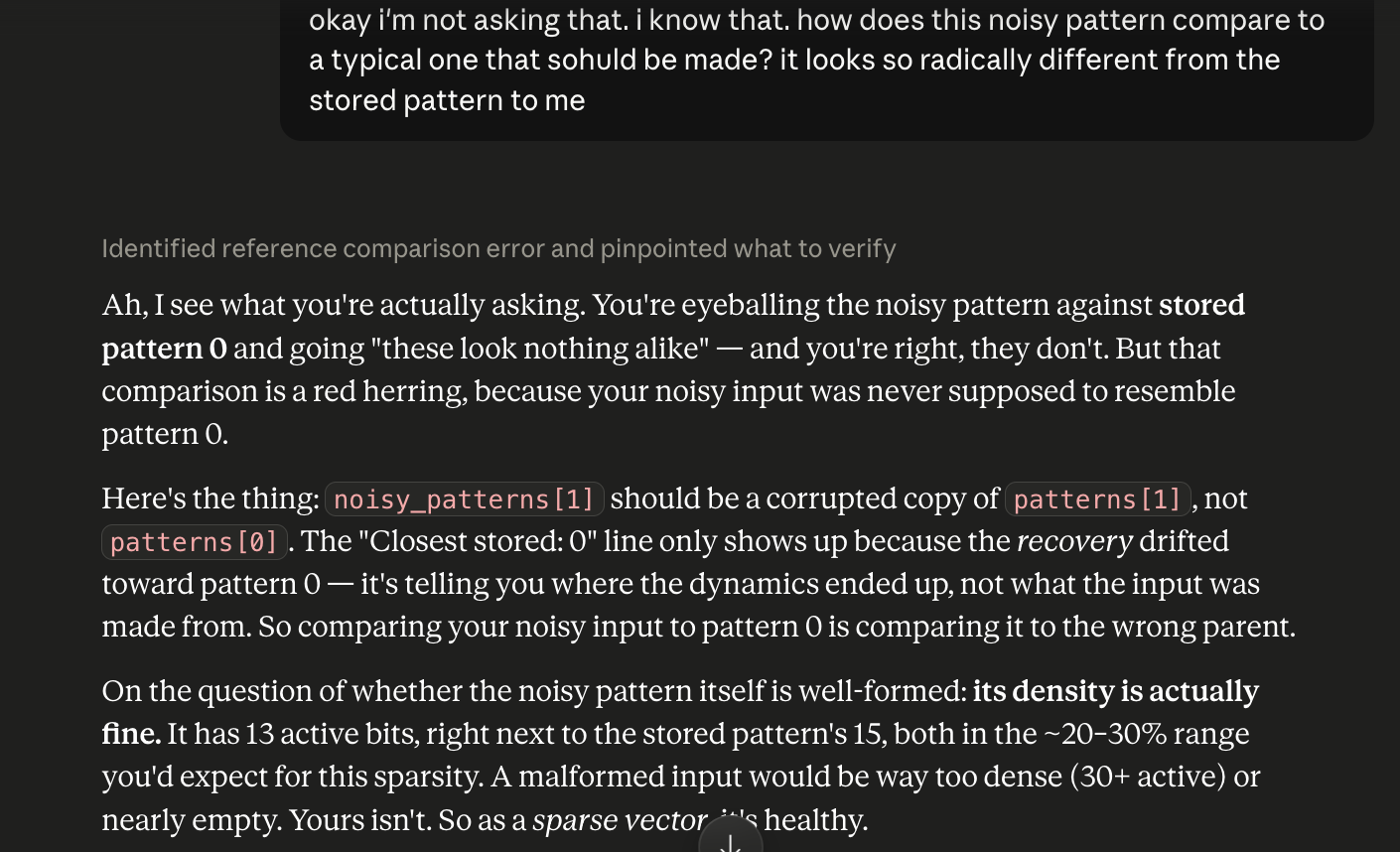
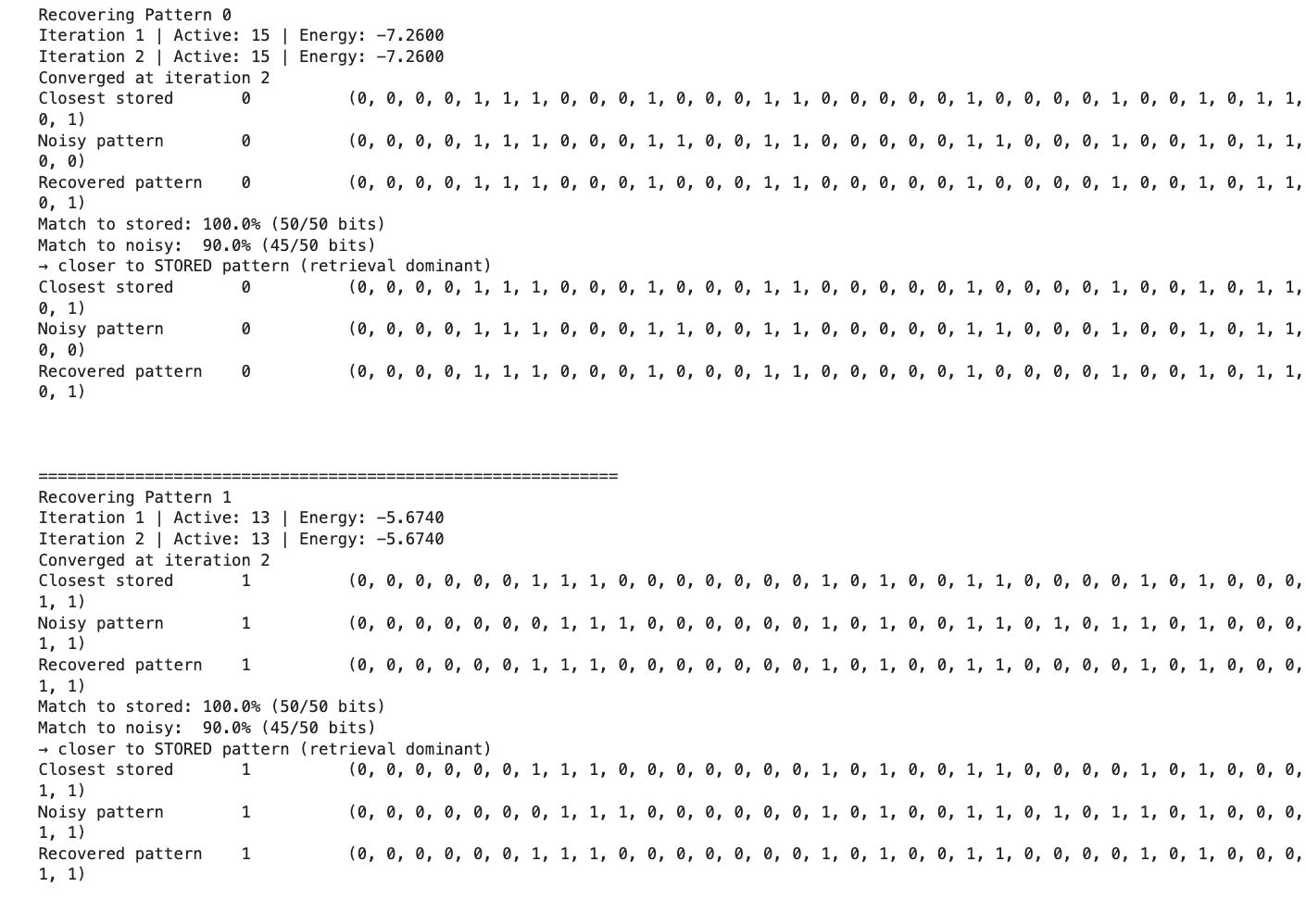
Claude was telling me it looked fine. I was a little suspicious but figured, “What do I know, at the end of the day.” Even so, I decided to check my working sparsely coded experiment against this defunct one. Surprisingly, the asynchronous update rule was identical. Pretty much everything was identical… minus the noisy pattern section. I went for a second check. I figured I should try to make my noisy pattern section the same as the one from the working experiment, just to check. I asked Claude why these two were different:

CLAUDE GASLIT ME!!! I knew the broken one had an issue. So I switched out the old noisy pattern section, ran the experiment again… PERFECT RECALL FINALLY!!!! I tried with multiple different seeds to make sure it wasn’t just something to do with that pattern. THEY WORKED!!!! Because for whatever reason, the output of my model printed a 0 before “Closest pattern” instead of a 1, Claude was focused on correcting that issue versus actually looking at what I was showing, which is that the noisy pattern was defective. Also, though, in all of the times I had asked Claude for support and had it read my full code, it never mentioned that the noisy pattern was corrupting twice as much. It was focused on making wider scale changes, primarily treating the issue as having something to do with a spurious attractor made somewhere inside the model. Once I fixed the messed up noisy pattern, it stopped mixing up those numbers and I stopped getting a 0 pattern in the 1s section.
I’ve mentioned multiple times that while AI has been a means to an end for me to do something I thought was important in this political context and as someone with lived experience, it is not my favorite thing. I saw an article this week on how Ford had to rehire 300 human engineers after firing them to replace them with AI.
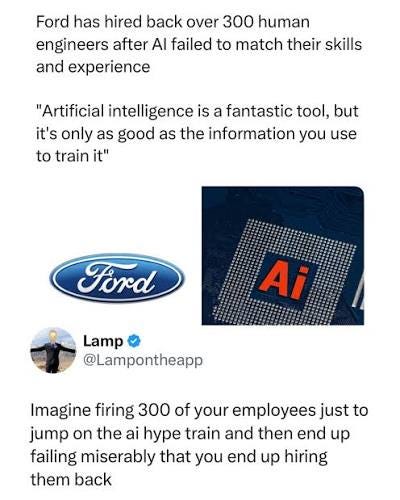
Here’s another example of why humans will not yet replace AI at all. I’ve reflected many times on how the people doing the mass-scale replacing probably have nowhere near the amount of intimacy I have gotten trying to do a skilled activity with AI. I did it because this situation was important enough to me, but even as a beginner, I have trumped it many times. For example, I made my pattern separation experiment based on the fact that as ACh goes up, it inhibits granule cells in the dentate gyrus. If I had listened to AI, this would not have gotten done because ChatGPT tried to convince me that this was not accurate. I started with little knowledge and have had to develop a lot of expertise throughout my project. The more “skilled” I became, the more AI seemed to fail me. I’m eternally grateful that I had this tool to wipe out one of the most difficult lacks in my life, which was the lack of understanding of dissociative amnesia. However, I do believe CEOs are doing simple things on it, like writing LinkedIn posts, and confusing that for an ability to do precise and highly skilled tasks. It is nowhere near there yet and will probably always lack the level of deep insight required when sourced from a general AI model like the LLMs the general public has access to. The AI used to do things like find heart tumors is better and more precise because it has one job and it knows how to do it. LLMs that learn everything do not.
The lesson of this week has also been that trusting yourself enables you to see solutions, while mistrusting yourself does not keep you as safe as you think. This weirdly matched the theme. For weeks, I was scouring the model for the bits I thought an “expert'“ would notice. The lam. The update rule. The bias. The normalization. I was scared because I am not an expert and I felt like I was running out of solutions within my scope. I thought the project was getting too difficult for me and was requiring some type of expert-level intervention. The solution ended up not requiring any type of “higher level” knowledge at all but just a little harder scrutiny of the simple things. Imposter syndrome can really be your own worst enemy.
I can’t tell if I’ve been a bit of an emotional sponge recently or I keep hitting disturbing content by chance or both. This week was a really emotionally loaded run of media — finishing the “Piano Teacher”, watching “A Woman Under the Influence” for the first time, and then watching “The Boy In Striped Pyjamas”. I would think it’s a me thing.
But after finishing my experiment troubleshooting, I left the house on an emotional high in search of a fun snack and a bit of a walk at 10:30 PM or so. On my way to my local Co-Op, I run across an older woman pulling a big suitcase. I hear her mumbling something and turn her way. I make eye contact and give her a smile, just to be polite. She’s standing there and huffing and puffing over the suitcase. She makes a brief comment about how she’s trying to pull it up the hill. I hesitate for a moment.
“How far away do you live?” I ask her.
“Just up the hill.”
These kinds of situations scare me because I’ve heard so many horror stories about human trafficking where someone asks you to help them with a baby or something like that. But I felt sad seeing her standing there with the suitcase.
I tentatively cross the street.
“I can help you with it if you want,” I said uncertainly. I hesitate again when I get over there, trying to gauge the threat. She could see that I was hesitating and in a raspy voice asked if I really wanted to. I told her I was just hesitating because the news gets things in your head sometimes. She said she’s not like one of those stories. I was like 50% 50% sure I was making myself a prime victim but I figured I would make a run for it if anything and grabbed the suitcase handle.
When I grabbed it from her, my stomach twisted. She was pulling it with a bad arm, slightly too short with all the mass piled up near the shoulder like a bone had fused.
We start making our way up the hill, with my nerves as tense as if I was in an active battle field. She tells me the suitcase is full of groceries. It’s heavy. Her brother is sick, she said (thought it took me a few tries to hear that it was her brother). He’s sick and he’s going to die right in front of her. He only has four months to live. She starts telling me everything, how hard it’s been for her taking care of him by herself. She has to make him all his food. He won’t even let a nurse come. She’s 65 years old, she has a “broken arm”, her words. I was concerned and asked her if she’d been to the doctor. From what I understood, she had but her arm was like that now.
“My sister died right in front of me too,” she said. “Cancer.” She reenacted the whole thing. She walked up and found her on the floor. She just tried to wake her up, thought she was asleep. All I could tell her was I was sorry. I told her if she ever needed me to, I would go to the store and buy her groceries. She hands me an old flip phone, and I struggle to put my name in.
“Food raquel” written with the flip phone keyboard.
I’m still worried I’m getting sucked into some kind of human trafficking scheme. I keep asking her if this is the house. It’s always a little further up the hill. She gets more into her life with her brother.
“He’s horrible, he just gets angry. Tells me I can’t leave the house.”
“Does he hit you?” I ask.
She nods bitterly. “Sometimes.”
She tells me she struggles to get the food up the stairs. I wished badly to help her, but also the abusive man + late night combination was triggering my anxiety. We finally make it to the top of the hill. I tell her I’m really sorry, I have to leave it right here because I’m expecting a call from my mom (I wasn’t, I just wanted her to think someone was waiting on me just in case). But I tell her to call me if she ever needs food.
“Honey, I’m not going to call you,” she says. “I don’t know you, I’m not going to ask you for food.” Her tone was sad, not angry.
She asks my name. I tell her. I head to leave and then turn around and ask her which of the apartments is hers.
“93,” she says.
I walk away with that really sticky feeling you get when you’re the kind of person that absorbs everyone’s emotions. I felt afraid for her and sick to my stomach. I quickly looked up hotlines to make a safeguarding call for elders. She said she would be homeless soon if her brother died. I asked her if she could get government services and she said she didn’t know how. I planned to call the next day but I still felt so wrong in my body. I just prayed for her and chose to go home and do some relaxation. She would be okay tonight, at least.
To relax, I decided to watch “Man In The Moon” with Reese Witherspoon thinking it was going to be a feel good movie. Just my luck, it ends with a boy getting chopped up by farm equipment. I don’t know what is in my energy recently. I’ve been in a great mood but everything is just gut wrenching and heavy and the improved mental health seems like it’s making me feel everything with enhanced clarity.
I’m one of those kinds of people that always ends up in a situation too. People who haven’t spoken to me in years call me by chance in a crisis, old ladies talk to me at random… If a person begging for money on the street saw nine other people and me passing by, I can guarantee you they’re going to approach me every time with laser speed. I was remarking on this with a coworker recently. Every time she and I go out, someone in a really dark emotional headspace starts talking to us out of the blue. It’s just something in our face or energy or something.
I decided to do a spiritual cleanse day on Sunday. The energy had felt really off recently. It was just little things that clued me in. I paid £110 for a pet clean last week and the very next day my cat had gotten unusually sick and brought it back to square one. Everything around me was dark and distributing no matter how good my energy. The final thing that got me was when I went into the bathroom to shower and a random corner, nowhere close to the window, was radiating with small, black bugs. There was no food there or anything which would have indicated that they should be there. It just felt like there was weird, bad juju around me. I may be a scientist now but I do believe in evil eye.
Maybe it’s cultural. In Brazil, you can pay people to do Macumba, Black magic.
My grandmother in Brazil had a farm for a long time that she let a family pay to use. After decades of living in the same small house, my aunts decided to help her pay for renovations. They decided to tell the family they were selling the farm. But the family was angry, trying to claim some equivalent of squatters rights. Finally, they were able to sell it but many issues ensued with the house. My grandma and aunt moved to a temporary apartment while it was getting fixed. Finally it was finished, so my grandma moved in. My aunt refused to move in with her because of mental struggles. Less than a few weeks after moving into this new house, my grandmother caught COVID and died.
You would think it would stop there. Despite refusing to move into the house, my youngest aunt claimed ownership and has never let it go despite my aunt and mom having the house passed down to them as well in the will. They went through a host of different cursed lawyers to try to get the house back. One ended up working with my other aunt behind their back. One ended up dying. This legal madness began in 2020/2021. It’s 2026 and it’s still going on. We can’t sell the house but my aunt isn’t even living in it. My mom was always suspicious that the family paid for a bit of macumba.
I like to look at everything as being for the best but this was the same year my parents separated and I dealt with my trauma. Bit of a cursed year for the Rocha women. Bad juju year.
So I do believe in people sending you bad energy. If I sense a shift in how my life is going, I always do a cleanse just to be safe.
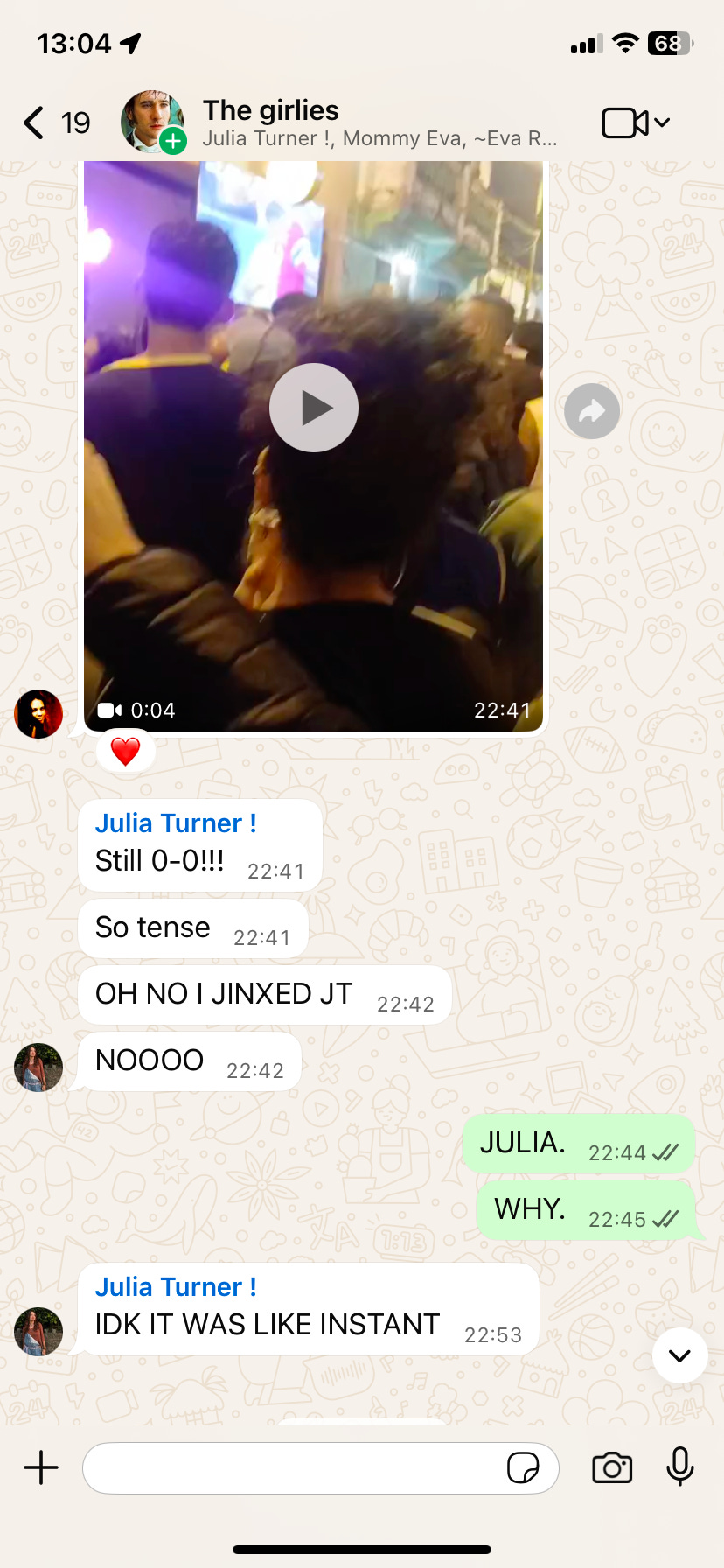
Brazil also lost the World Cup on my way home. Whoever put evil eye on me, COUNT YOUR FREAKING DAYS!!!
I won’t share my exact cleansing methods because that’s opening yourself up to bad luck but just know it was like spraying the shit out of myself with spiritual Febreeze and I know it sounds fake but when I got home, I got the intense urge to deep clean. I went through every shelf in the whole kitchen, throwing away multiple bags, and packing things up to leave. Weirdly enough, when I opened the door to the bathroom, the bugs were making a beeline to the window which didn’t make me feel much better at first but a few hours later, they had entirely vacated the area. I still planned on spraying the floor extensively on Monday morning and caulking up the random tunnel they had made out of the blue in the divet right in the corner by the bathtub and the wall with the door, of all spots. But I was happy they chose a more polite option. It was much nicer than the horror-movie-esque display 6 hours prior. Nothing could bring Brazil back into the World Cup but at least the vibe was good.
It’s good to be rational but sometimes you have to cover your bases on every possible dimension just on the off-chance.
On Monday, I took some time to orient myself. My period was in full swing so I was pretty much like this:

One of my best friends since middle school was flying in the next day for 10 whole days. I was applying to new jobs, still trying to get creative about my current one, and slightly stressing about the upcoming deadline for my dissertation, which made me feel a little discombobulated as I was having back-to-back visits from loved ones all month. I also tried to call Adult Social Services for the woman but I didn’t have her full name, so they couldn’t do anything even though I had her address. So there goes another side plot. I feel like I can’t really just leave her now. I’ll have to keep an eye out for her or someone who might know her.
I went for one last frolic in East Dulwich which consisted of a mindfulness meditation in the grass. I mentioned earlier in the reflection how the biggest trauma “releases” often happen under your nose without any intentional effort. As I laid in the grass, I realised I wasn’t really that angry at Columbia anymore, not because they had done anything to facilitate that obviously, but because this project really did help me process a lot of those emotions.
I mentioned in an earlier reflection how justice is a personal word. When I felt unheard and cheated by the Title IX process, I grieved a justice system that felt like it was built to make me fail. This person would never be expelled and would probably never go to prison. I didn’t have the emotional energy to trigger all that, especially after this first attempt hadn’t worked. I was upset because I felt institutionally disempowered. That year upended my ability to make good grades or finish my senior thesis, which was painful and lowered my self esteem. I also felt like people saw me as a liar and that my rapist had extra protection on campus now, which triggered me.
I left with a big angry daydream of finding the root cause of dissociative amnesia and proving to everyone that I wasn’t lying, finding something so impossible that no one could say I wasn’t telling the truth anymore. Because if I was lying, how would I even be able to do something so hard and impossible?
And I did it. That was healing for sure. It was empowering and validating, especially because deep down, I was worried they were somehow right. Maybe I was crazy all along. But if the craziest thing I ever wanted to do actually ended up being quite a rational choice, then I wasn’t really as crazy or fantasy prone or socially suggestible as I thought.
Even so, I was angry a lot of the way through. It fuelled my passion a lot and stopped me from giving up. I was tired of feeling small and squashable. I wanted to feel powerful. But I think this last piece of my journey, writing my story, was what really cemented in the healing. When you do a Title IX trial, they make you sign a confidentiality agreement so you won’t share anything said in the trial itself. They also make you sign a retaliation policy so you won’t retaliate against the person in the trial or the Title IX team. If I had made a post on social media talking about what my rapist did with his name, I could have been retaliating against him. If I tried to publish some kind of article, I could be retaliating against the school, especially if I mentioned elements of the trial that I found unfair. Some of the things said by my rapist or in the investigative report felt incredibly unfair, one sided, or harmful. I wish all the time that I could share it but I legally cannot. When I first finished the trial and was angry and full of grief, that really amplified it because I felt silenced and that scared me. It made me feel like I would never get justice not a only against him but against them. I went in with one hurt and left with two.
Being able to write my experience in these essays in my own way has been healing. I feel freedom and like my experience is mine again. It’s not the story of how I was wronged, which is where I thought this would end. It’s been something funnier and much more interesting which was my experience healing myself as a scientist. I feel like I’ve pivoted away from the anger and hurt and it’s just me and my work, my future, my potential. It was a gift I didn’t expect to get.
They say forgiveness is not for the other person but for you. So I honestly forgive all of them. What happened wasn’t okay and I’ll keep fighting for an improvement, but I’ll do so without the anger and the fear. This is my story and my power that I reaped and I’m grateful.
This week, I briefly considered whether to run my figures on R Studio, which we learned in my program, or Python, which is more standard procedure for computational neuroscience. I decided to opt for the second, meaning it shouldn’t really take too long to get those images or honestly even run my numbers. But I still needed to make one last experiment, which was a combination of both parts running together. After that, I’d be all set to just focus on writing which I needed to get to ASAP to have a first draft ready for both of my supervisor. A little stressful but with my model fixed, it felt like my biggest and most annoying challenge was already behind me.