Starting Again: Weekly Reflections on a Personal Journey
Tuesday Reflections on my journey towards a computational model of dissociative amnesia

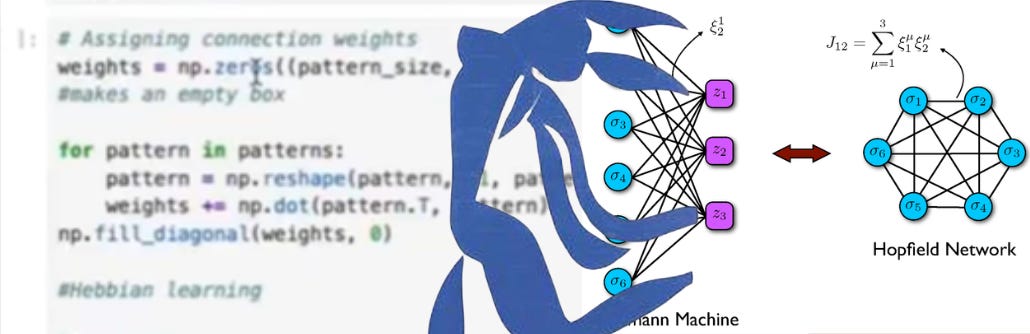
My intention to be more selfish this week resulted in me taking a bit more time for myself and working on my personal project. I skipped a little bit more work and class, despite being in my last two school days of my master’s program. Practicing sending an internal “Thank you for the amazing opportunity, but I’m at my emotional capacity at the moment”, I opted to let myself breathe a little from the end of one of the busiest years of my life. This week also coincided with the one year mark of my personal project journey on the 28th of March. It has been the most challenging and rewarding stretch of time and I can’t believe how much I’ve grown in every possible way.
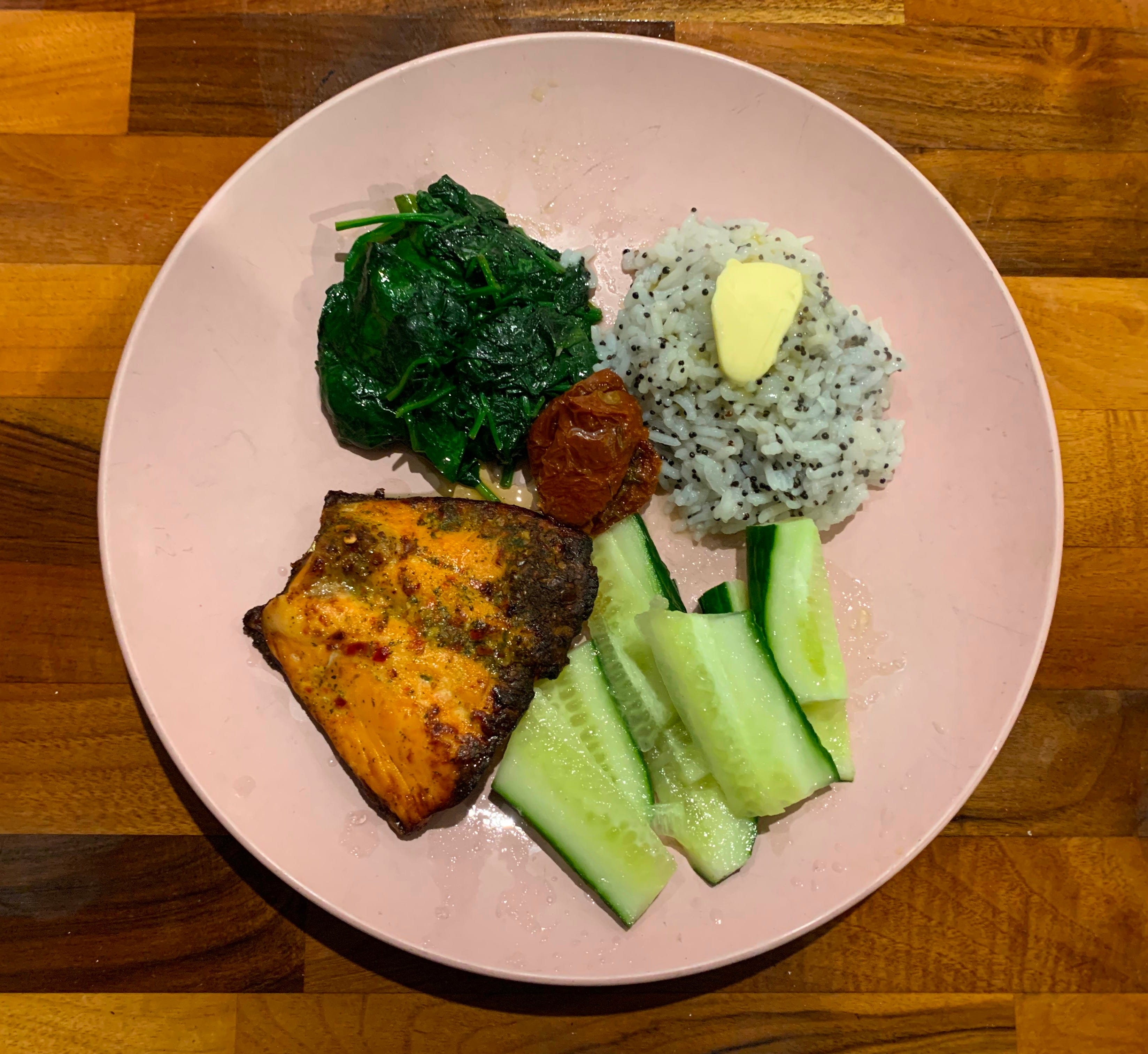
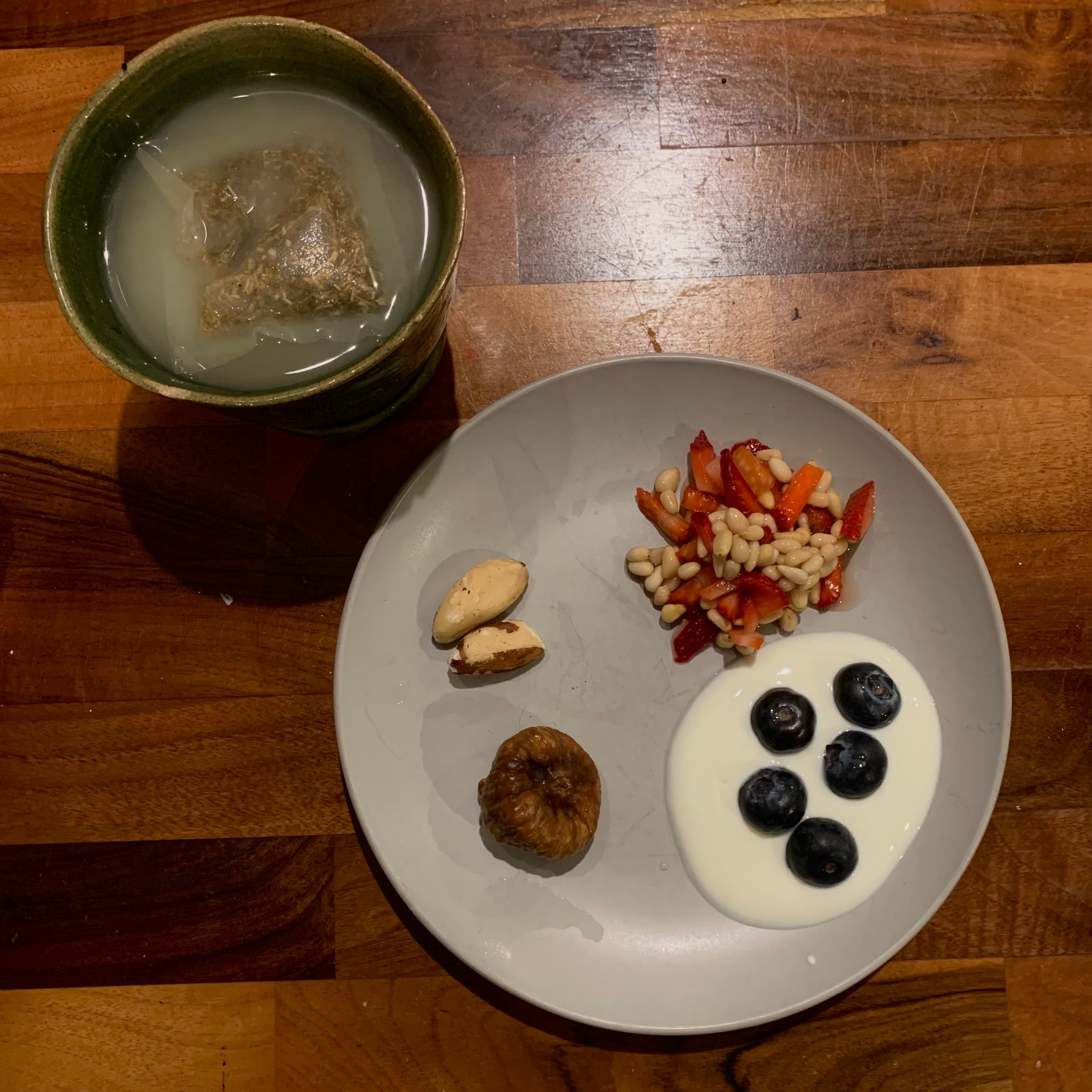
I also took some time to reflect on the intense burnout I have been feeling, opting to switch my diet in ways that would support my brain health and hormonal health a bit. As mentally and spiritually stimulating as my early 20s have been, they have been tough on my body.
On the last day of class this past Thursday, I had a premature moment of excitement. I spent some time exploring assumptions and trying to deduce how exactly to put Acetylcholine (ACh) in my Hopfield network. Math has not previously been my favorite but I will give myself this: I can absolutely crush some simple addition and multiplication. Not to brag.
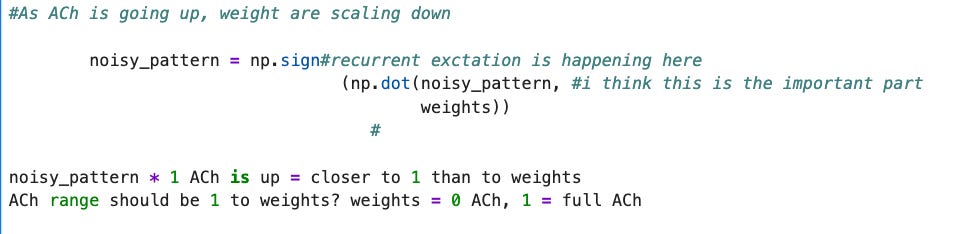
So I sat and deduced the simplest possibly solution.
I know that I need the memory to be pretty much exactly the same as the noisy pattern if ACh is all the way up. So that’s like multiplying it by 1…
I know that if there is no ACh, recurrent excitation is all the way up. That’s the same as if the Hopfield network ran normally. So… “no ACh” is the same as weights.
What now?
I went back to ChatGPT, which had preemptively given me a solution when I asked a question about where ACh should be situated. I had completely ignored it in the moment, not only because I wanted the pride of solving the problem, but also because my trust in ChatGPT’s code writing skills was low.
However, its solution was near identical to mine, so I plugged it in to see.
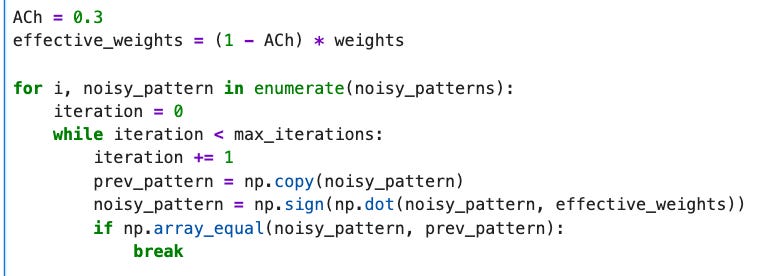
Now here is the irritating part. In the midst of my end-of-the-day haziness, I ran the code and it seemed as if it had worked. The recovered pattern was similar to the noisy pattern when ACh was high, and similar to the original pattern when the ACh was low. Hallelujah! I’m a computational neuroscientist. I went to sleep smug in my problem solving abilities and the simplicity of the task.
The next morning, disaster strikes. I had tried to send a video to my dad the night before, but WhatsApp crashed mid-send. I assumed my message hadn’t gone through and went on with my day. I woke up the next morning and spent some time experimenting with sparse coding and higher neuron counts, with some bumps along the road. I should have sensed that something was off because my new code with the sparsely coded patterns was not changing no matter how the ACh was shifted — but I had more internal issues so I figured they were the result of some of the new terminology I was gearing up to learn, like attractors.
My dad called around 1 PM to ask what I meant about my theory working. It seems the message had sent but not my video. I laughed and told him I would send the video to show him. As I was recording, I noticed an issue. Nothing was changing. The patterns were identical no matter what.
What happened?
I had come up with a solution through my own logic and expert ability to multiply by 1, and ChatGPT had come up with the same idea. It seemed perfect. I moved to another chat and asked if it could tell my why nothing was moving in my code.
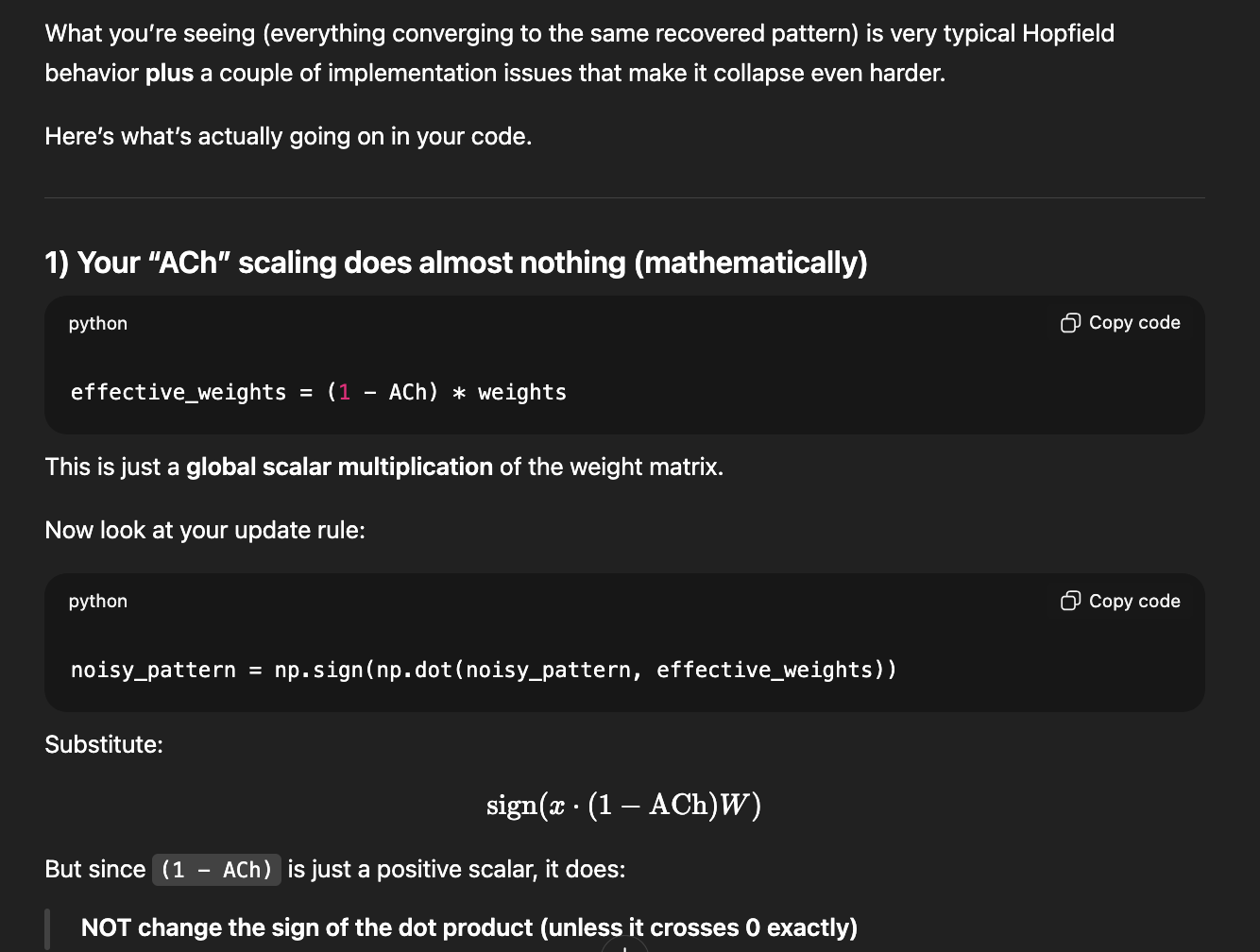

It seemed as if I had just hallucinated the patterns changing in the midst of my exhaustion. With this unintentionally sassy correction, my irritation towards ChatGPT was at an all time high.
Wasn’t that what you suggested? Wasn’t that the code you wrote?
God I hate ChatGPT.
I started using ChatGPT because I had loads of passion and a big problem to solve, but no one to believe in me until I could propel myself upwards by quite a bit. My affection towards my annoying little chat box has gone up and down along the course of this project. At times, I’ve felt intense relief and gratefulness at its cold companionship which has allowed me the opportunity to tackle one of the largest problems in my life. But I would also trade it for a good degree and a community of peers in a heartbeat. TBH, in that moment, I would probably trade it for a stick of gum and a shoelace.
I felt quite defeated after that bump in the road. The last few years in my life have required extensive problem solving, with this project being one of the most obvious manifestations. I silently cursed the amount of learning I would still have to do past this point just reading ChatGPT’s brutal assessment of its own code. I also felt quite stupid that I had thought I had gotten it, only to look back and see that I was so far off. But I’ve been reminding myself at this point in my project that failure is part of the game. I will inevitably fail countless times before I get to my final destination.
In fact, I have already “failed” quite a bit. My first attempt at implementing ACh in my neural network was to make a function that flips the neurons so that they inhibit the connections. That was wrong because it would not suppress the memory, but corrupt it instead.
Previously, we had my attempts to narrow down my idea which resulted in many possible final models, including synaptic tagging, the amygdala, the HPA axis, and a host of other possible combinations of ways to imagine dissociative amnesia.
Before that, I had the great Sharp Wave-Ripple Search of ‘25, where I had ChatGPT code my entire code, thus resulting in a 2 day, 12 hour total search for where on Earth the Sharp Wave-Ripples were and why they weren’t printing in my output. We then had the moment I realized that the model had been encoding the SWRs, meaning that the consolidation window was accurate, but the information encoded was completely distorted.
And even before that, we had my original attempts to understand what this model would include. When I first started this project, I had wanted to make a “narrative" function, to see what my model remembered. I had no experience back then and no sense of what was possible. Now I know that I can just see what memories were recovered through patterns in my Hopfield network. But back then, I was really scratching my head trying to understand how to get a neural network to “tell me” its memories.
Do I need to build a sense of self or something?
Thank God the answer to that was no, though that would have really been a real marvel of computational neuroscience.
I took solace in remembering that every scientist I’ve ever encountered on the Internet has attested to the amount of failures required for any discovery, and decided to go on a walk to clear my head. There I reflected on how frustrated and tense I’ve felt, and how much I’ve been dying to finish this project. All this time, I’ve been wanting to finish so that I can finally relax in the knowledge that I had become a neuroscientist. I’ve felt awkward and illegitimate throughout this entire process, like I was taking a possibly doomed leap of faith. Finishing the project felt like it would give me the reassurance I needed that I wasn’t wasting my time. But as I walked, I realized that in all this time trying to become a neuroscientist, I was already being one. I had read countless texts, created multiple different theories, and was all the way to the point of coding a Hopfield network. You can’t become something you already are. There wasn’t any wait, in reality. I was searching for the start of my career but I already started my career last year when I began this project.
Actually, writing that gave me a bit of a chill down my spine like I’d just jumped into the middle of a new story. It’s bizarre, isn’t it? I’m already kind of in it. I don’t think there’s any backing out of it at this point.
On Saturday, I finished “Why Men Love Bitches” and had a long think about my love life, finally deciding to start again. For the last few years of existing post-trauma, my love life has been mostly on pause except for unexciting side stories here and there. I’ve struggled to go out not only to build a love life again but to build a new community in a new city. The last three years especially have been a high pressure push of getting myself situated and surviving masters and this project. There hasn’t been much time to process my own internal world, nonetheless add a new facet to it.
But as I started to put out some new feelers, I took a minute to reckon with everything holding back from rebuilding life again. I had a healing cry that hadn’t seemed to come for a long time. I thought about the perception of the love life I would have pre-trauma. It felt lighthearted and girlish. I took a minute to feel grief and anger at the robbery.
I had never had sex before this trauma occurred in my life, which was also a central element of the emotional difficulties with this abusive person that year. Surviving sexual trauma changed my perception of the dating world drastically and pushed me out into the next chapter of life with a lot of fear and cynicism. The frustrations I had with men post-trauma aggravated me and disrupted me in ways that they might not disrupt other people. Feeling unheard or objectified were not mere side effects of masculinity to me to put up with affectionately for me. They triggered me immensely. It would really aggravate me when I felt I didn’t feel emotional power or when I felt trampled on. I took a minute this week to feel a lot of anger and irritation towards the patriarchy that had made me feel disempowered and unheard in so many ways. I thought to the frustrations I had with psychology, the painfulness in undergrad, and the feeling of powerlessness I had felt in my relationships with men.
I hate being a woman. It sucks.
I also grieved the forced intimacy of navigating my sex life again post-trauma. I held myself back out of fear of a trigger, a freeze, or maybe just emotionality at what to me was something big and vulnerable. It made me feel awkward and distant from my peers who were having lighthearted fun. I have nothing against lighthearted fun. I wanted lighthearted fun too. But I also felt anxiety and grief and confusion, particularly in a world of men who are not too fond of the patience and intimacy my emotional pain required. The loving pushes around me to get back into things or to just have faith often made me feel more withdrawn. I didn’t have control over how this trauma happened to me. Subconsciously, I wanted to control how I engaged with sexuality without pressure from people who hadn’t dealt with what I did. I didn’t want to do it for them. I wanted to do it for me.
Feeling like I was different or like I couldn’t navigate my own sexuality in a way that was “normal” for people my age had slowly been sapping me of my self-confidence and making me feel isolated. But as I landed in a new headspace near the end of this project in a more stable place in life, I decided I owed it to myself to take small steps in a way that centered me, finally feeling ready and safe. I took a moment to feel all of my anger at being pushed around, pressured, and coerced by a system of power that trickled down from the government and into the minds of people around me. I sat with the futility of trying to avoid it and thought about how to find my own power within it in my own way. I reminded myself to ignore anyone’s voice and desires but my own and to be the person that I needed throughout this process.
Over the course of this project, my mind has drifted often to the idea of post-traumatic gifts. One of my post-traumatic gifts has been seeing my own desire as something sacred, something that should be for me and not for receiving validation or feeling “good enough” or “like everyone else”. While I’ve been slow to reenter the world of interpersonal intimacy, I’ve felt that it has also been a positive reflection of my unique incentive to sit with my own body and really take time to think about how I feel about somebody. As women, we are often told to shut down that scrutinizing voice in order to feel beautiful or acceptable or loved. Many women without sexual trauma also feel used or like they felt they had to give their own control away in order to survive the pressures of the patriarchy. That’s a struggle we all share regardless of whether we suffered a trauma or not. There was nothing bad about me in particular and letting myself choose based on my own authentic desires without coercion was a good thing.
And with that emotional baggage out of the way, I went out clubbing and had some victorious intimacy firsts.

I woke up early in the morning the next day for my side job with a goodbye kiss and another person’s jacket on by accident. Afterwards, I wandered around for a very long time to process where I’ve been.
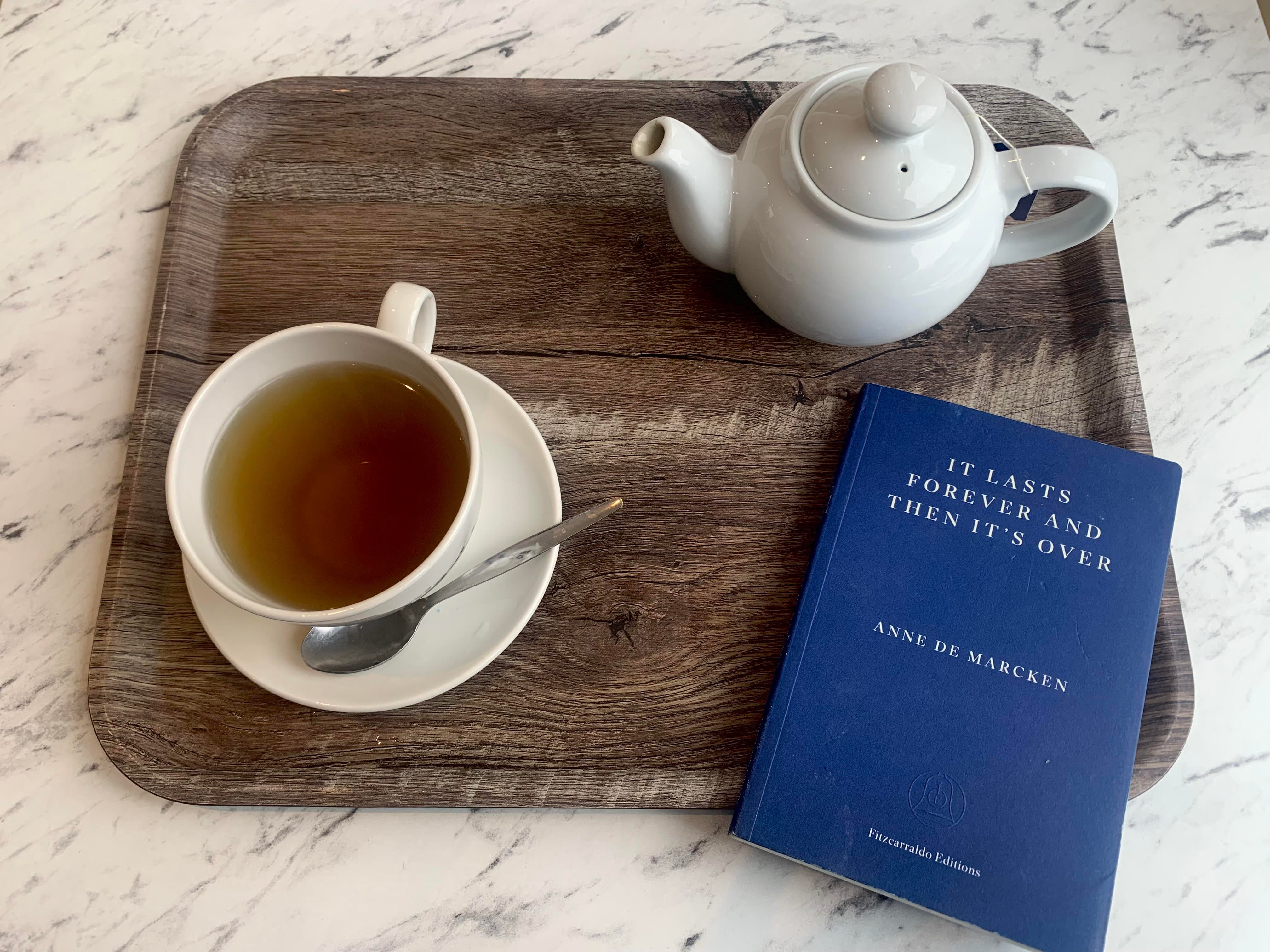
I thought about everything from my relationship to my body to my budding neuroscience career. Near the middle of my London hike, I stopped at a coffee shop in Blackheath for some peppermint tea and a brief reading session. I’ve just started reading “It Lasts Forever and Then It’s Over” by Anne de Marcken. The book is somewhere between a poem and a novel. It tells the story of a zombie who is grieving life after death and reprocessing her relationship to herself in a decomposing body.
De Marcken’s tale has been my first dip back into fiction in a few years since heading down a more political and STEM path. Interestingly, I notice myself relating to my old love with a new neuroscience vocabulary. On the train heading to the club, I spent the first few pages of my book thinking about our innate human draw towards telling tales. I mentally drew the picture of the hippocampus, our built in narrative builder, which threads together information spread across minute to years, integrating them into narratives bundled by axes of information called “nodes” - people, places, even themes that bind the information cohesively.
We were literally made to be storytellers.
And in the coffee shop, as I read about de Marcken’s protagonist finding a new sense of freedom from burrowing a dead crow wrapped in cloth into her undead body after grieving the loss of an arm, I thought about Andy Clark and David Chalmer’s notion of the extended mind. Their interesting theory posits that the mind is not locked exclusively into the brain or the body, but can be externalized into new locations like notebooks and items. In other words, the mind is not a physically locked-in entity, but a process which is always building itself in conjunction with its environment.
I marveled at my own new arm of sorts, this neuroscience limb that I’ve grown along the course of this process which feels both lovingly foreign and like an inherent part of me that was always meant to be there.
On Monday, I let my bosses know I was taking the day to reorganize and gave myself some breathing room to process.
I decided to give my computational model another try and sit with what was working and what wasn’t. What I’ve learned in my minimal amount of time spent deep-diving into neural networks is that there are a lot of little knots and failures you can bump into, even if your system is relatively simple. Codes are delicate little machines that seem to have a bit of a life of their own. You can accidentally create oscillations somehow. Your model can collapse. It can get too excited and blow up the neural network with 1s. It’s a bit maddening, but well suited to my bizarrely patient, persistent, and obsessive personality. Not to say that this project hasn’t tested my patient countless times. But even patient people are not immune to irritation; they just choose to be the master of their own minds rather than letting their minds be the master of them.
I spent a long time in the afternoon getting into the nitty gritty of computational models — attractor basins, chaotic attractors, transformers, and temperature. Learning as I go along has been overwhelming and has felt seemingly endless. There’s always a new lesson to learn around the corner. But to borrow a metaphor from the terminology I learned today, with every iteration in my learning process, it seems I approach a more stable state.

This week I learned that starting again can really change your perspective, even if you don’t cross the finish line. My goal for next week is to take some time to get mentally and emotionally organized and prepare for bigger successes.
I have a personal life philosophy that if you’re feeling stuck, the best way to call in your end goal is to reduce friction. Sometimes we get so focused on the most obvious part of the vision that we don’t notice all the little knots holding us back. If you can untie some of those, the solution to your problems will often just rise to the surface naturally.