My Beginner Computational Neuroscience Reading List
The books that got me through my first big project and beyond

Note: I’m a beginner in my mind until I’m in a masters or PhD program so I’ll keep updating until then!
I kept these in the order I read them because I think they make a good trajectory that builds well on itself in complexity and content for self-learners like me! Highly recommend pairing this with downloading Jupyter Lab and running a simple Hopfield network itself or otherwise once you get past “Surfing Uncertainty” or so. I’ve linked the one I used here which is about as simple as you can get and can just be copy-pasted as is into Jupyter Lab.
I also made a list of free beginner resources I used to help me do things like find research articles or learn Python:

“Rethinking Consciousness” by Michael S. A. Graziano
This book is not computational neuroscience specific, but a great beginner neuroscience book for people wanting to learn some really foundational ideas that you will hear in other areas time and time again. It was actually my first dip into the world of neuroscience and it was amazing one. It’s so entertaining and well-written. You will come out of it feeling so knowledgeable about the inner mechanisms and manifestations of attention in particular, as well as other interconnected themes. This book set me up with vocabulary that was necessary to understand the next book on the list, which was my first computational neuroscience book. It has a great overview on the biology of other animals as well. Graziano also explores other theories of consciousness in his book to contrast them against his theory, the Attention Schema Theory. He even ends with an exploration of the future of consciousness science and what it would mean for us to have a unified theory of how it works in the technological age.
It’s a fun, insightful, and novice friendly book that I would recommend to anyone.
“Surfing Uncertainty: Prediction, Action, and the Embodied Mind” by Andy Clark
If you read “Rethinking Consciousness” and “Surfing Uncertainty”, you will honestly already have an amazing grasp of some of the most important theories in neuroscience. I felt so comfortable and knowledgeable when I took introductory courses on neuroscience later on because I was so familiar with attention and predictive processing. The books actually overlap in material quite a bit in a lot of ways.
“Surfing Uncertainty” explores the idea that our brains are predictive machines that are always constructing the world in unseen and important ways. Clark explores what happens when those predictions are disrupted or our prediction-making inner function is broken. What was the most important to me is that he explained how those neurological features could be translated into neural networks. His initial overview of neural networks was what sent me on my way. I was shocked that a machine could learn how a brain could!
”What Is ChatGPT Doing ... and Why Does It Work?” by Stephen Wolfram
Written by one of the giants of AI, this book is short and very digestible to a general audience. In fact, I wish everyone would read it (yes, even the biggest AI haters) because I think we would be having a very different reaction to these models if people knew how they actually worked. I learned that Large Language Models (LLM) like ChatGPT are doing everything they’re doing through simple predictions. They’re just a bunch of statistics that are processing the concept so much less than you would assume, and doing a lot with that. These AI models produce the sensation of understanding and comprehension that would make you think that they were actually grasping and interacting with the content in a much bigger way than they are. They definitely don’t even comprehend you, nonetheless know if you’re a space being reincarnated on Earth or the future king of the world. And I think more people should learn why that is.
Personally, I also learned about a lot of key AI vocab in this book like temperature.
”Make Your Own Neural Network” by Taqriq Rashid
This book is more of an actual manual for people who are interested in playing around with neural networks using free resources like Jupyter Lab. It was really useful for me when I got into the actual coding I was doing but it’s also got a very approachable explanation of how the math works and how neural networks do things like categorize images. I’m not a great video learner so this book really helped things make sense for me, because many of these types of manuals already assume you’ll have the kind of in-depth understanding to jump right into the jargon. The tone is fun and informal which keeps it approachable and it even features actual code that you can pop right into Jupyter Lab to play around with. It’s great for people who want to experiment or take a hands-on approach.
And actually even for the general audience, you would be surprised how little code these complex machines require and how much they can do with so little from a home laptop.
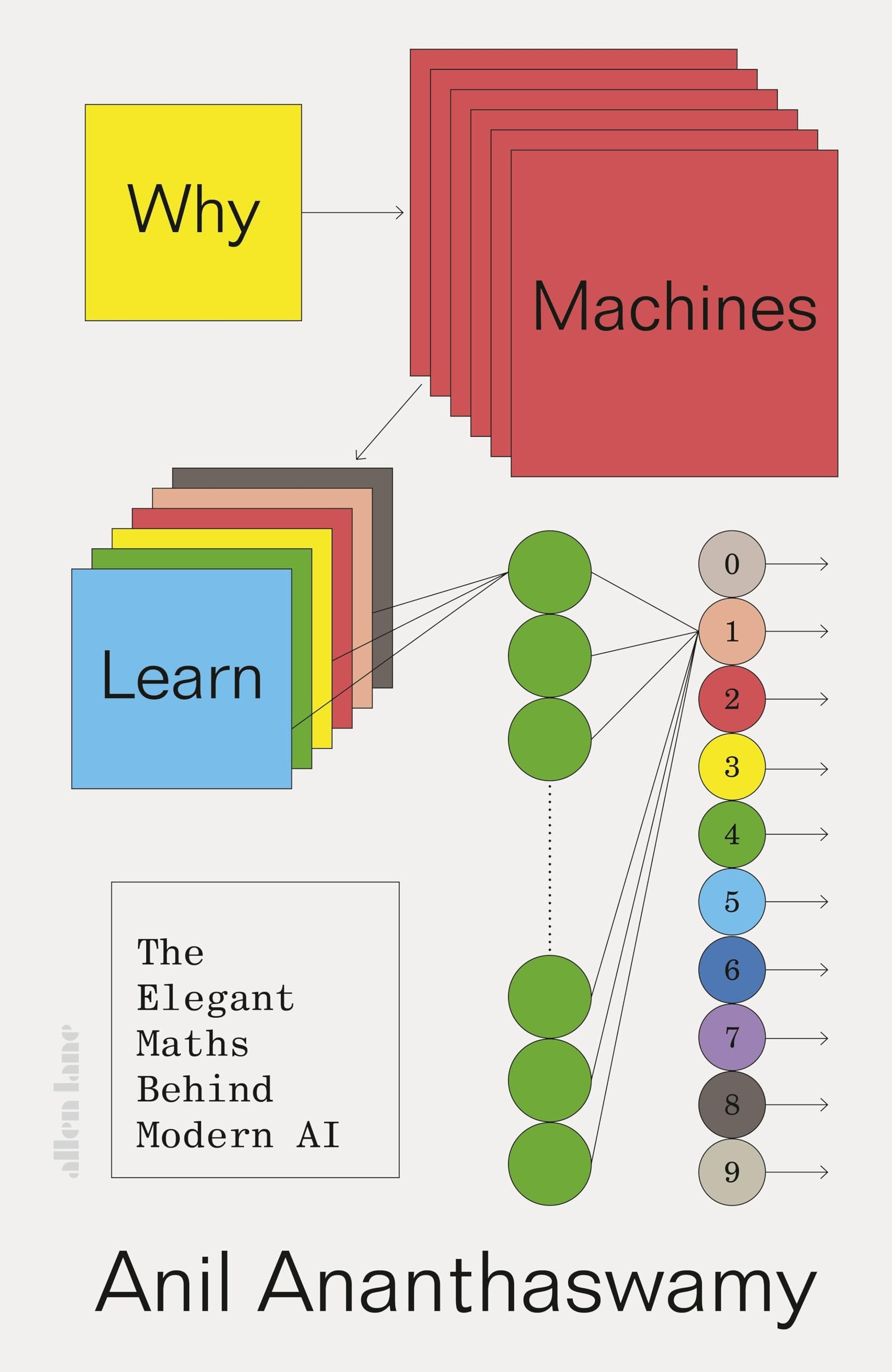
“Why Machines Learn: The Elegant Math Behind Modern AI” by Anil Ananthaswamy
A pretty self-explanatory title. I used this book to teach me how weights worked in a Hopfield Network from a mathematical perspective, which then gave me all sorts of insight into other parts of my code that I hadn’t really understood as well as I could. It’s a really approachable read with good images and examples. Very intuitive! I think it’s best for people who already have a little bit of relevant math skills or who have actually utilised machine learning in some context, even at a very beginner level. It makes it easier to have a frame of reference for what’s going on. I broke down a simple Hopfield network first to see how it worked, then read the book above this one for some more insight on the coding language itself, then read this one once I’d really gotten comfortable running my Hopfield network to get a more thorough understanding of the math and that was a great order to utilize these books in, personally speaking.